Cixin Liu is one of the most important voices in modern science fiction globally. His writing is deeply rooted in hard science, with an equal weightage to philosophy, cosmology, human nature, existential inquiry and the nature of existence itself.
His Remembrance of Earth’s Past trilogy redefined large-scale science fiction, expanding the genre from planetary conflicts to universe-spanning existential questions. This work is not just limited to stories about aliens or advanced technology, in fact he explores what happens when humanity confronts the true scale and indifference of the cosmos.
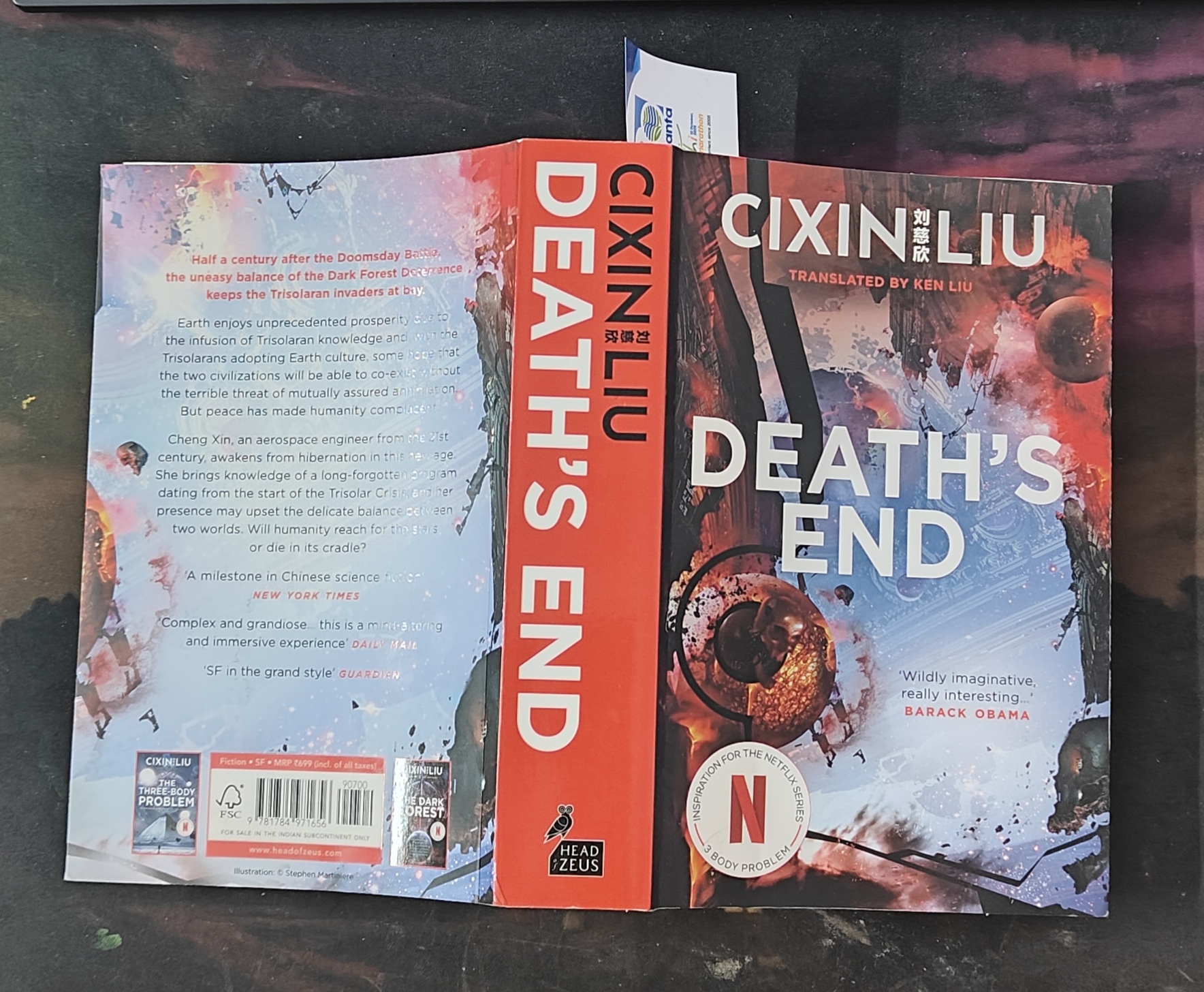
And I’m in absolute awe of Death’s End, especially after reading the pre-sequel The Three-Body Problem & The Dark Forest. The presentation, the plot build-up, story-within-story, characters, socio-political milieu, the emotions, everything is just… spot on!
I have so much to say about it that I decided to split my thoughts into two parts.
This post serves as a detailed summary of the book, drawn from notes I made while reading. Over time, I realised that these notes grew quite extensive, and so I decided to divide the content into two installments. The first one here, focuses exclusively on the novel’s summary, while the second will present a comprehensive review.
A Universe that Keeps Getting Worse the More You Understand It
Death’s End stands as the final, devastating installment of Liu Cixin’s Remembrance of Earth’s Past trilogy.
Spanning centuries and multiple eras with breathtaking scope across eons, the universe is painted in the most bleak and hopeless vision. Civilizations come and go quickly, like tiny insects, and over time, the universe gets more and more unfriendly to anything complex or alive.
At first, it’s about humans fighting desperately against alien enemies. But then, it turns into something much worse, as the plot unfolds we realize that everything in the universe is ultimately doomed to end, and that the universe offers no inherent meaning.
A Haunting Opening that Sets Everything in Motion
The novel opens with an elaborate, almost surreal prologue set in Constantinople in 1453, during the final Ottoman siege that would topple the Byzantine Empire. A mysterious woman named Helena, described with unsettling beauty, with “a feverish glow” in eyes, approaches Emperor Constantine XI with an impossible proposition:
she possesses supernatural ability to reach into sealed, locked spaces, to make the inaccessible accessible.
She demonstrates this terrifying gift by retrieving treasures from a sarcophagus buried deep within Hagia Sophia’s ancient foundations, sealed for nearly a thousand years behind stone walls “as massive as those in the Great Pyramid of Cheops”.
The guards had watched the Anatolian prisoner continuously, so obviously no one could have entered that sealed chamber. Yet Helena extracted a complete human brain without breaking the man’s skull, leaving him dead yet unmarked.
This haunting prologue sets the tone of the book right at the beginning.
A Final Decision, and a Sudden Interruption
The narrative then shifts to introduce Yun Tianming, a lonely, isolated aerospace engineer dying of stage-four lung cancer metastasized throughout his body. His life has been consumed by quiet suffering. Born to intellectually elite parents who demanded classical education and refinement, he yet lacked the social cunning to succeed.
By adulthood, he has become a profound loner, oversensitive, withdrawn, incapable of meaningful connection. His career stalled and his love life became nonexistent. His only source of light across four decades has been an unrequited love for a woman named Cheng Xin, met in college. He remembered her through a single perfect afternoon at a reservoir where she sat beside him and tossed pebbles into rippling water.
The cancer is terminal, his own sister, wanting to preserve their inheritance and free herself from his medical burden, has orchestrated circumstances that push him toward euthanasia. Consequently, Tianming accepts and enters a decorated euthanasia room, horrifyingly decorated with fresh flowers and pink paper hearts, making it simultaneously cheerful and tomb-like. He faces digital prompts on a screen. Five times he must click buttons in random positions to confirm his desire to end his life. Five times the mechanical female voice asks: “Do you wish to terminate your life?”
But as he progresses to the last option, Cheng Xin arrives to stop him.
He Bought her a Star She Would Never Reach
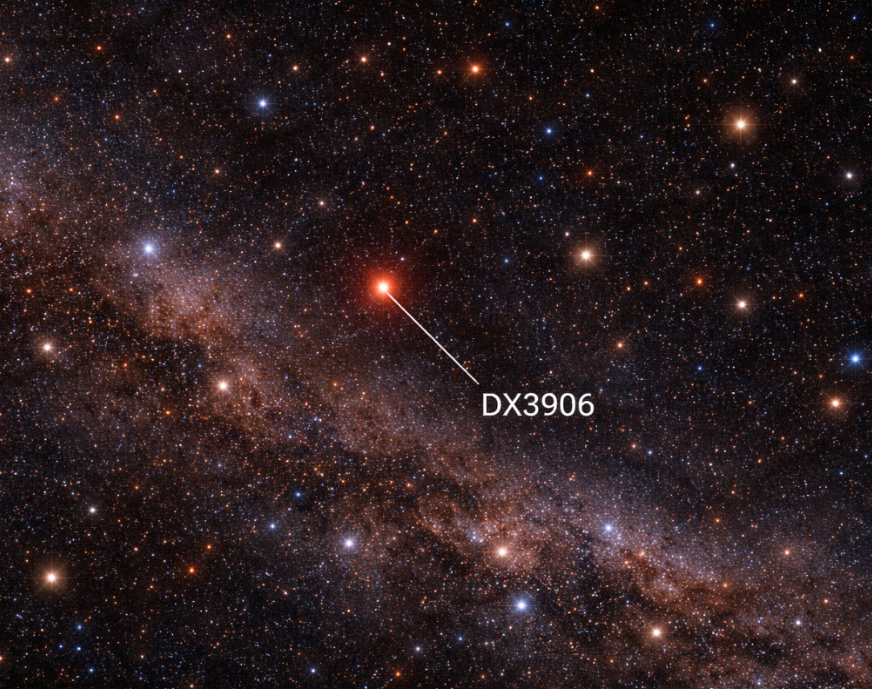
Before entering that clinic, Tianming had made one final, heartbreaking gesture. Using three million yuan given to him by Hu Wen, a college classmate who built a beverage empire on Tianming’s casual, drunken college advice about creating an “organic drink” from grass and weeds, Tianming purchased a distant star: DX3906, located 286.5 light-years from Earth.
He registered the title under Cheng Xin’s name, ensuring that somewhere in the infinite cosmos, there exists a world that legally belongs to the woman he loved but never confessed his feelings to. The astronomer Dr. He, who facilitated the purchase, was moved by the profound poetry in this act:
“It’s not just about money. It’s about romance. Romance! Do you even understand?”
The star is nearly invisible, apparent magnitude 5.5, requiring peripheral vision to detect, requiring the observer to look away from it directly to see it. When Tianming finally sees DX3906 under the late-autumn sky, searching through Dr. He’s careful instructions until finding the faint red point between other stars, the astronomer tells him something that crystallizes the novel’s entire philosophical trajectory:
“Even so, I think you’re blessed. Most people don’t cast a glance at the universe beyond the world we live in until the day they die”.
The light Tianming sees has traveled for 286 years. By the time Cheng Xin sees this same star, Tianming will have been dead for centuries. Yet he persists in creating meaning anyway.
An Uneasy Peace built on Mutual Destruction
The narrative then leaps forward fifty years after the Doomsday Battle. Humanity has achieved peace with the Trisolarans through the Dark Forest Deterrence. This is mutual assured destruction elevated to cosmic scale, both civilizations possess the ability to broadcast the other’s location to hostile aliens across the galaxy. Should either attempt aggression, the other triggers the broadcast, ensuring mutual discovery and destruction.
This equilibrium of mutual threat has held for decades and so an uneasy peace reigns. The age of existential terror gives way to unprecedented prosperity. Human science advances rapidly with Trisolaran technological knowledge, cultural exchanges occur and humans and Trisolarans begin coexisting as equals.
But this is Liu’s masterful setup for catastrophic disillusionment.
Cheng Xin awakens from cryogenic hibernation into this new era, carrying knowledge of ancient programs from the crisis’s beginning. She becomes an aerospace engineer and intelligence operative for the Planetary Defense Council’s Strategic Intelligence Agency (PIA), discovering humanity’s most ambitious project:
construction of a lightspeed spacecraft, a vessel representing humanity’s ultimate aspiration, that is, escape from the solar system and sanctuary somewhere in the infinite cosmos.
At the PIA headquarters, an old, austere six-story building resembling granite, located near UN headquarters, Cheng Xin encounters Thomas Wade, the agency’s chief, who then looked younger but in an unsettling way.
When the Universe Itself Turns Hostile
Beyond Earth, fragments of humanity had already begun to scatter. Deep-space vessels like Gravity and Blue Space represented humanity’s earliest attempts to escape the Solar System. But even here, the logic of the dark forest prevailed. When these ships encountered other human vessels, uncertainty and fear led to preemptive destruction. Humanity, even in isolation, proved incapable of trust. Survival demanded suspicion, and suspicion led inevitably to violence.
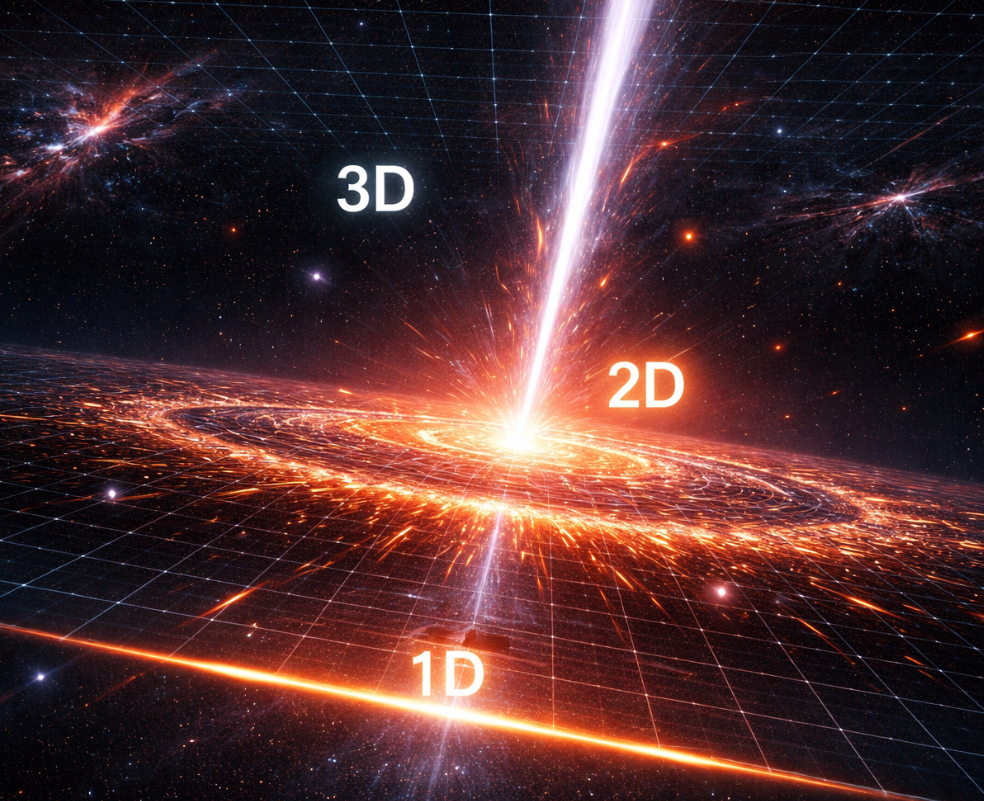
As the novel progresses, the fragile equilibrium collapses. Both civilizations face a threat that the universe itself is entering a state of dimensional decay. The three-dimensional space both species depend upon is being systematically reduced dimensionally by civilizations billions of years more advanced, using weapons that weaponize the fundamental laws of physics itself.
This understanding does not come from human discovery alone. It is later articulated by Guan Yifan, a surviving physicist, who reveals that the most advanced civilizations in the universe do not merely build weapons, they weaponize the laws of physics themselves.
In interstellar wars fought across galaxies and superclusters, spatial dimensions and even the speed of light become tools of attack and defense. A “dimensional strike”, he explains, is not an isolated phenomenon but a common method of warfare among godlike civilizations, capable of collapsing entire stellar systems into lower-dimensional space.
Through the existence of “dimensional reduction” as a weapon of advanced civilizations, Liu Cixin transforms abstract physics into existential dread.
A stellar region can be deliberately flattened into two dimensions, eventually, stars become flat lines and planets become points. Entire civilizations become impressions in a two-dimensional plane, their three-dimensional complexity erased.
This weaponization of physical law represents the ultimate turning point. Since, the weaponized by civilizations are so advanced they exist in dimensions humans cannot perceive.
The Dark Forest Deterrence becomes meaningless. Both humanity and Trisolaris realize they are not each other’s primary threat rather they are both victims of the same universal horror. Yet knowing this doesn’t change their situation.
Cooperation between species is theoretically possible, but practically impossible as both remain trapped in the dark forest logic where trust is impossible when survival is uncertain.
A Human Consciousness, Drifting among Aliens
A critical element emerges through Yun Tianming’s unexpected transformation. Rescued from his suicide attempt, Tianming becomes a bridge between humanity and the cosmic community. His physical body is dying, but his mind remains sharp.
In a decision both desperate and visionary, humanity preserves his brain and launches it into space as part of a long-shot strategic program. As per the initiative, his brain is sent towards the Trisolarans as a form of contact. Or it can also be said as an experiment,
a human consciousness cast into deep space, carrying with it memory, longing, and the fragile imprint of human thought.
He is received not as a prisoner, but as something closer to a subject of study, an entry point through which the Trisolarans attempt to understand humanity itself. Gradually, surviving within their domain under strict limitations, Tianming adapts to their methods of communication.
He communicates with the universe using fairy tales and metaphorical narratives, so he uses cryptic messages encoded in stories rather than direct language. His communications warn of the true nature of the dark forest universe.
Through Tianming’s tales, especially “The New Royal Painter”, “The Glutton’s Sea” and “Prince Deep Water”, he conveys warnings that the Trisolarans themselves are not humanity’s ultimate threat. Both species are equally doomed by a universe that gradually reduces dimensional space, eventually making all complex life impossible.
The universe’s physical laws are against them, which implies that the fundamental structure of reality is hostile to both, consciousness and complexity. Both human and Trisolaran civilizations are engaged in ultimately futile struggles against inevitable universal dissolution.
Humanity Tries to Survive the Unsurvivable
In the novel’s later eras, humanity constructs “Bunker Worlds”, which are sealed regions of space meant to preserve civilization from dimensional reduction. Protected by unimaginable technological barriers, these bunkers attempt to preserve culture, science, art, and consciousness against universal decay.
However, these attempts merely delay the inevitable. The dimensional reduction weapons, once unleashed by advanced civilizations engaged in their own wars, cannot be stopped. As Guan Yifan later reveals, these weapons are not anomalies but remnants of ancient cosmic wars, conflicts so vast that they have already reshaped the fundamental structure of the universe itself.
Entire stellar regions collapse from three dimensions into two, then one, then cease to exist entirely.
The lightspeed spacecraft becomes both humanity’s greatest hope and greatest delusion, a means of escape that leads nowhere, because the destruction of dimensional space is not limited to Earth’s solar system but propagates throughout the cosmos. Thus, there is nowhere to flee, every refuge eventually becomes subject to dimensional reduction. The universe is systematically removing the conditions for complex life. Not through heat, but through geometric deconstruction by fundamentally altering the laws of physics.
Cheng Xin watches as humanity exhausts itself trying to preserve meaning, culture, and civilization against the relentless march of universal entropy. She witnesses civilizations rise, achieve technological miracles, and gradually disappear as their dimensional context collapses.
- The Bunker Worlds fail.
- The lightspeed spacecraft reaches nowhere.
- All the brilliant strategies of survival become irrelevant when the basic structure of reality itself is being dismantled.
The End of All Structure, All Meaning
The novel’s conclusion occurs approximately 18 billion years after the start of the Crisis, as the universe approaches heat death. Liu presents a cosmos dying not through dramatic catastrophe, but through slow, implacable thermodynamic decay. All structure dissolves into disorder, meaning collapses into randomness and all consciousness dissipates into unconscious particles.
Stars burn out.
Galaxies disperse.
Space itself collapses into lower dimensions, then ceases to exist.
Eventually, the universe progresses toward its final state of perfect entropy, where nothing can change, where no energy difference exists to permit work, where consciousness is absolutely impossible. The second law of thermodynamics becomes the universe’s final law.
Cheng Xin and the final remnants of humanity face a cosmos that confirms the darkest interpretation of the dark forest theory:
life and consciousness are cosmic errors, the improbable states of organization in a universe that fundamentally tends toward disorder and death.
Liu’s conclusion is spiritually devastating, for many, but not for me. I’m in sync with the idea that the universe itself would be “better off” without life, without consciousness, without meaning.
A universe of perfect entropy is superior to a universe containing conscious suffering. Existence is the problem and annihilation could be a possible solution.

The Final Argument for Being Human
Yet Death’s End does not conclude in despair. Instead, Liu argues that conscious beings achieve their greatest dignity not through technological triumph or escape from cosmic prison, but by accepting the fact that we are small and not important on a cosmic scale.
The characters continue building, loving, creating art and knowledge, not because it will ultimately matter in cosmic terms, but because conscious beings cannot help but create meaning. Meaning-making is the essence of consciousness itself.
Tianming gives Cheng Xin a star she will never reach. Cheng Xin accepts a universe devoted to her destruction. Others compose music, write books, pursue knowledge, all activities absolutely meaningless from a cosmic perspective, yet absolutely essential from a human perspective.
Death’s End concludes that the appropriate response to a meaningless universe is not suicide or surrender, but the continuing creation of local meaning, moments of work, love, understanding, exploration, moments as brief and fragile as the faint light from a distant star reaching across 286 years of void to touch a human retina.
These moments are special because they don’t last forever. And even though everything will eventually end or fade away, humans (and other conscious beings) still choose to love, create, and find meaning.
This is Liu Cixin’s final word:
humanity’s tragedy is not that we die, but that we persist in meaning-making despite knowing we die. Our greatest strength is our ability to create beauty in the knowledge of absolute annihilation.
So, the question that I’m left with is, if the universe is destined to erase all meaning, then is our defiance in creating it the only thing that ever truly mattered?