
Scientists at the University of Utah have discovered that brain immune cells called microglia use calcium signals to trigger and respond to anxiety and compulsive grooming in mice.
Our brain is running a surveillance system around the clock. Not through neurons firing across synapses but through immune cells called microglia. And according to a new study published in Molecular Psychiatry, these tiny cells active participants in how we feel anxiety, develop compulsive habits, and potentially, how things go wrong in disorders like OCD.
The research, led by Naveen Nagarajan and Nobel laureate Mario R. Capecchi at the University of Utah, reveals that microglia use calcium ions as a messaging system to both trigger anxiety and grooming behaviors and to record that those behaviors are happening at all. It’s a two-way conversation, happening in real time, inside the living brain.
First, What is Microglia?
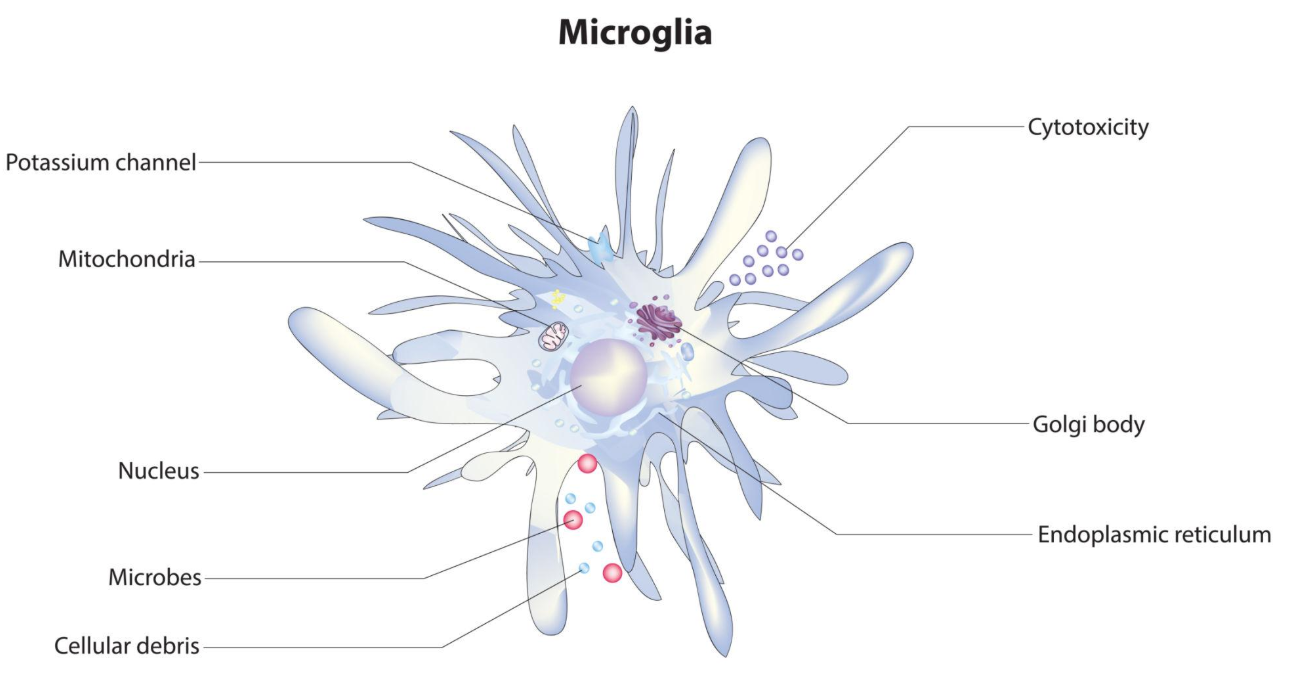
Microglia are cells that make up roughly 10-15% of all cells in the brain. These cells patrol the brain constantly, their activities include clearing debris and fine-tuning how neurons communicate with each other.
What makes this study fascinating is the discovery of two distinct types of microglia in mice, each with its own developmental origin and job description:
- Non-Hoxb8 microglia: born earlier in development, making up about 75% of total microglia in the adult brain. These act like molecular accelerators, pushing up anxiety and grooming behaviors.
- Hoxb8 microglia: born slightly later and comprising about 25% of the brain’s microglial population. These work like molecular brakes, keeping those behaviors in check.
When both populations are working in balance, behavior stays normal. When the Hoxb8 “brake” population is disrupted either by gene mutation or experimental manipulation, the result is chronic anxiety and compulsive, pathological over-grooming that looks a lot like trichotillomania, a human condition where people compulsively pull out their hair.
Microglia’s Hidden Signals
Calcium is one of biology’s most versatile messengers. Every cell in our body uses it for something. Neurons fire partly through calcium, muscles contract through calcium. But what Nagarajan and Capecchi found is that microglia are using calcium to communicate behavioral states, a role no one had clearly demonstrated in a living, freely moving animal before.
To uncover this, the researchers designed a series of experiments that tracked microglial calcium activity in real time during natural behavior.
Step 1: They Taught Mice to Wear Tiny Brain Cameras
The team implanted miniature fluorescent microscopes, almost the weight of a large coin, onto the skulls of genetically engineered mice. Inside the mice’s brains, tiny glass lenses (called GRIN lenses) were surgically placed into specific brain regions:
- the dorsomedial striatum (DMS)
- the medial prefrontal cortex (mPFC)
- the ventral hippocampus (vCA1)
The Hoxb8 microglia in these mice had been genetically engineered to carry a calcium reporter, a fluorescent protein that glows brighter when calcium levels rise inside a cell. So whenever a microglial cell flooded with calcium, the camera could see it light up in real time.
Critically, the mice were freely moving throughout all of this. They could walk around, groom themselves, eat, and freeze in fear all while their microglial calcium activity was being recorded.
Step 2: They Triggered Grooming and Anxiety
To induce grooming, the researchers either misted the mice’s faces with a fine water spray (triggering mild, brief grooming) or placed a small drop of mineral oil on their fur (triggering extended, vigorous grooming lasting several minutes).
To trigger anxiety, they used a looming disk test, projecting an expanding dark circle onto a screen above the mouse, simulating the approach of an aerial predator. Mice instinctively freeze when they see it.
Step 3: They Watched the Microglia React
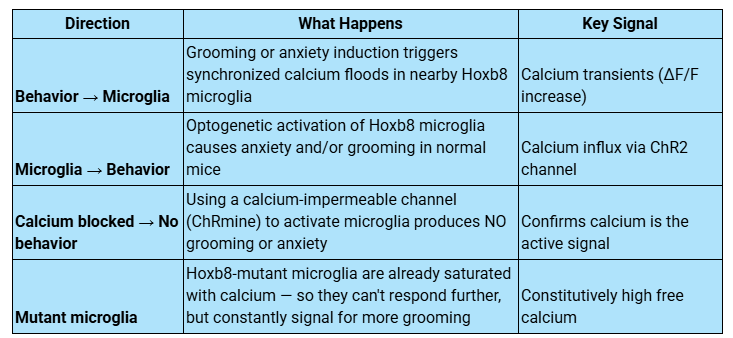
What happened next was the core discovery. Within less than one second of the grooming or anxiety stimulus, multiple Hoxb8 microglia simultaneously lit up with calcium transients, synchronized bursts of calcium flooding into the cells in concert.
The calcium activity was:
- Locked to the behavior: it appeared when grooming started and stopped when grooming stopped
- Proportional: more grooming bouts produced more calcium transients
- Synchronized: many microglia within the same brain region responded together, not randomly
This pattern was seen in different brain regions, the DMS and mPFC when the mouse was grooming, and the vCA1 part of the hippocampus when the mouse was feeling anxious. In simple words, these brain cells seem to be keeping track of what the mouse is experiencing.
Turn Off Calcium, Turn Off Behavior
One of the most elegant experiments in the study was a simple substitution. The team had previously shown that shining blue light on Hoxb8 microglia (using a channelrhodopsin protein called ChR2) induces anxiety and grooming. ChR2 is a light-gated channel that lets multiple ions flow in, including calcium.
The question was, is calcium specifically responsible for the behavioral change, or is it just general ion activity?
To answer this, they swapped ChR2 for ChRmine, a different channelrhodopsin that allows ion flow but specifically excludes calcium.
The result was clean, activating Hoxb8 microglia with ChRmine produced no grooming and no anxiety whatsoever. Not a single behavioral change. The mice behaved as if nothing had happened.
This experiment proved that calcium is not just one signal among many, it is the signal that microglia use to tell neighboring neurons to crank up grooming or anxiety.
Scientists Recreated OCD-Like Behavior in Healthy Mice
Mice with a disrupted Hoxb8 gene develop chronic, pathological over-grooming. They pull out their own fur. They show persistent elevated anxiety. For years, researchers knew this happened but not exactly why.
This study finally fills in that molecular gap.
In Hoxb8-mutant mice, the microglia carry a broken version of the gene that normally helps them store calcium inside the endoplasmic reticulum (ER), a cellular organelle that acts like a calcium reservoir. Without this storage capacity, free calcium builds up permanently inside the mutant microglia’s cytoplasm.
It’s as if the brake pedal is stuck down, but instead of stopping, the car accelerates. The constantly high calcium levels mean the microglia are perpetually sending signals to neighboring neurons to produce more grooming and more anxiety. There’s no “off” switch.
When the researchers induced grooming in Hoxb8-mutant mice, the microglia showed no additional calcium response. They were already saturated, they couldn’t register “more”, because they were already at maximum. And yet, they were still continuously broadcasting the signal for heightened behavior.
The researchers also showed that they could recreate this pathological pattern in healthy mice simply by exposing Hoxb8 microglia to repeated, sustained optogenetic stimulation, loading them up with calcium over days and weeks until the mice began pulling out their own fur.
The direction of causality becomes unmistakable, too much calcium in Hoxb8 microglia causes the pathology. Full stop.
What the Neurons Know
Interestingly, neighboring neurons don’t stay passive during all of this.
When the team stimulated Hoxb8 microglia with blue light in the DMS and vCA1 regions, nearby neurons showed elevated expression of c-Fos, an immediate early gene that marks neuronal activation. In other words, the stimulated microglia were clearly talking to neurons, and the neurons were listening.
When no optogenetic stimulation was given, the c-Fos expression was absent. The neurons only activated when the microglia told them to.
This adds another layer to the story:
microglia and neurons are engaged in genuine, bidirectional dialogue, with calcium as the primary language on the microglial side.
Takeaway: The Brain’s Immune Cells Might Hold the Key to Quieting Anxious Minds
Science has spent decades building detailed maps of how neurons create thought. This study suggests we may have been ignoring some of the most important cartographers.
Microglia are not passengers in the brain, they are co-pilots. They listen to behavior, they record it in calcium, and they signal neurons to modulate it. When that calcium economy breaks down, the results look remarkably like some of the most treatment-resistant psychiatric conditions we know.
So the next obvious question is, how many other behaviors, emotions, and mental health conditions are being regulated by signals we’ve spent years attributing entirely to neurons?
The calcium was always there. We just weren’t watching the right cells.
Source: Nagarajan N. & Capecchi M.R.
“Microglia respond to and induce anxiety and grooming in mice using calcium signaling”. Molecular Psychiatry, 2026. https://doi.org/10.1038/s41380-026-03572-w
Frequently Asked Questions
Q1: What are Hoxb8 microglia, and why do they matter?
Hoxb8 microglia are a specific subpopulation of brain immune cells that originate slightly later in embryonic development than the majority of microglia. They make up about 25% of total microglia in the adult mouse brain and function as molecular “brakes” that suppress anxiety and compulsive grooming behaviors. When the Hoxb8 gene is disrupted, these brakes fail, leading to chronic anxiety and pathological over-grooming similar to OCD-spectrum disorders in humans.
Q2: How does calcium signaling in microglia relate to anxiety?
When Hoxb8 microglia are activated — either by real anxious experiences or by artificial light stimulation — calcium ions flood into the cells. This calcium surge acts as a signal to neighboring neurons, instructing them to produce anxiety or grooming behaviors. Conversely, when mice experience induced anxiety, their microglia respond by generating these calcium bursts, suggesting a two-way conversation between behavior and brain immune cells.
Q3: Could this research lead to new treatments for OCD or anxiety disorders?
Potentially, yes. By identifying calcium regulation within specific microglial populations as a key mechanism in compulsive and anxious behavior, this research opens a new therapeutic avenue. Targeting microglial calcium channels or storage proteins could — in theory — reset the brake/accelerator balance in brain circuits governing these behaviors. However, translating mouse findings to human treatments takes years of additional research, and human microglial biology, while similar, has its own complexities.
Q4: What is the Accelerator/Brake model of microglia function?
Researchers propose that the two populations of microglia in the brain — Hoxb8 and non-Hoxb8 — work in opposition, like a brake and accelerator in a car. Non-Hoxb8 microglia drive up anxiety and grooming (accelerators), while Hoxb8 microglia hold those behaviors in check (brakes). Under normal conditions, their balance keeps behavior within healthy ranges. When Hoxb8 microglia malfunction, the accelerators dominate and behavior becomes pathological.
Q5: How did researchers observe calcium activity in the brains of living mice?
The team used a technique called microendoscopic imaging — essentially implanting tiny GRIN lenses deep in specific brain regions and attaching miniaturized fluorescence microscopes to the animals’ skulls. Mice were genetically engineered so their Hoxb8 microglia produced a fluorescent protein (GCaMP5G or GCaMP6f) that glows brighter when calcium levels rise. The mice could move freely while their microglial calcium activity was recorded in real time, frame by frame.
Q6: What does the ChRmine experiment prove?
ChRmine is a light-activated ion channel that, unlike the standard ChR2 used in optogenetics, does not allow calcium to enter cells. When researchers used ChRmine to activate Hoxb8 microglia with light — providing the same ionic stimulation but removing calcium — no grooming and no anxiety were induced. This directly demonstrates that calcium is not just a byproduct of microglial activation, but the specific molecular signal that instructs neurons to change behavior.