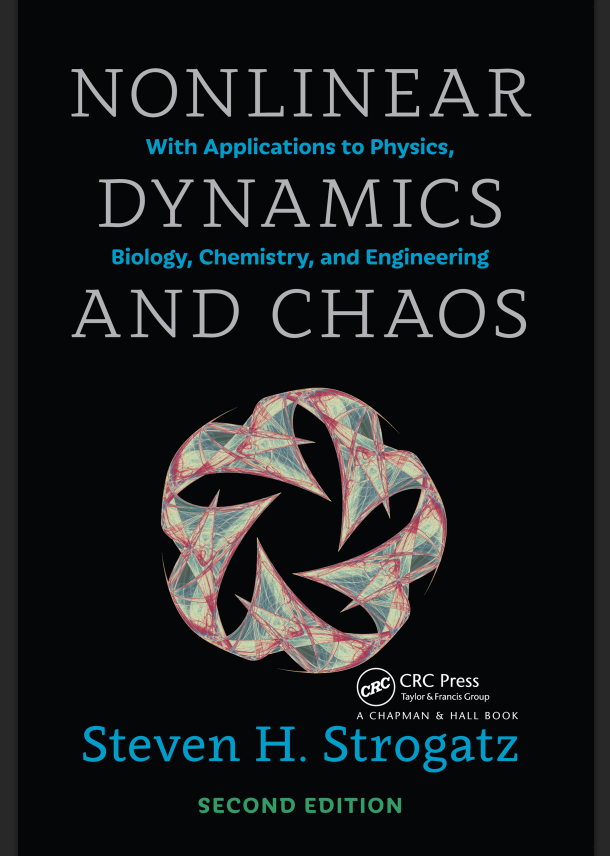
I picked up Nonlinear Dynamics and Chaos by Steven H. Strogatz because I wanted to explore how simple rules can create a world that is anything but simple. Before I got to the book, I listened to Strogatz’s lectures at Cornell, and those lectures intrigued me enough to want to read his work. There was something about the way he could take an idea that initially felt intimidating and make it feel almost intuitive. It made me curious about whether I could understand the mathematics without first becoming fluent in the mathematics. More than anything, I wanted to see if the book could change the way I look at systems I encounter every day.
The book was first published in 1994. It’s about how things change over time, like a heartbeat or a swinging pendulum, even the weather, and why some changing systems settle into a steady rhythm, while some snap suddenly from one state to another, and some become completely unpredictable or “chaotic”, even though nothing random is going on.
Strogatz builds up the ideas slowly, chapter by chapter, mostly using pictures and real-world examples instead of heavy math. And that is the reason I could comprehend in the first place 🙂
Simple Doesn’t Mean Predictable
The book opens by explaining why nonlinear systems are so interesting. In a linear system, effects are always proportional to causes, such as double the push, double the response and obviously such systems are easy to predict. Most of the real world isn’t like that. Small nudges can sometimes cause huge, disproportionate changes like an avalanche, or a market crash. That’s one of the reasons why it’s difficult to forecast weather, ecosystems, hearts, and lasers.
Strogatz then gives a quick history from Newton’s predictable universe, to Poincaré’s discovery over a century ago that even simple systems can behave wildly.
In the late 1800s, he introduced a new point of view that emphasized qualitative rather than quantitative questions. For example, instead of asking for the exact positions of the planets at all times, he asked “Is the solar system stable forever, or will some planets eventually fly off to infinity?” Poincaré developed a powerful geometric approach to analyzing such questions. That approach has flowered into the modern subject of dynamics, with applications reaching far beyond celestial mechanics.
Poincaré was also one of the first scientists to notice the idea of chaos. Chaos happens when a system follows fixed rules but still behaves in a complicated and unpredictable way. Even a very small difference in the starting conditions can lead to very different results later, because of this, it can become impossible to predict what will happen far into the future.
Let’s say you’re tracking a single number over time, for example, the size of a population. Strogatz introduces a simple visual trick, instead of solving equations, you can just draw a picture of “which way things are moving” at every value, like arrows on a number line, and immediately see where the system settles down (a stable point, like a ball resting at the bottom of a bowl) or flies away from (an unstable point, like a ball balanced on top of a hill).
He applies this to population growth, both unlimited growth and growth that levels off because of limited resources. He also shows an important, almost surprising fact, a system that depends on only one changing quantity can never oscillate back and forth on its own, it can only settle down or run away. This means, real back-and-forth rhythms need at least two interacting quantities, which is why the book moves on to more variables later.
Then Things Suddenly Shift
There’s an interesting thought experiment in chapter 3. What happens as some outside condition like temperature or funding is slowly turned up? Sometimes nothing dramatic happens but sometimes the system’s whole behavior shifts abruptly. A stable state disappears, or the system suddenly jumps to a completely different state. These tipping points are called bifurcations, and this chapter catalogs the basic ways they happen.
Real life examples include, how a laser suddenly switches on once pumped hard enough, a bead on a spinning hoop that pops from resting at the bottom to resting off-center once the hoop spins fast enough, and, most vividly, a model of forest insect outbreaks, where a slowly growing pest population can suddenly explode into a devastating outbreak, and (frustratingly) can’t be brought back down just by reversing whatever caused the jump.
This one-way jump behavior, called hysteresis, shows up in many real crises, from ecological collapses to economic ones.
Things Start Moving in Sync
In chapter 4, Strogatz looks at systems where the changing quantity is an angle or a cycle, like the hands of a clock, or a firefly’s flashing rhythm. Rather than a straight-line quantity that eventually stops, this phenomena lets a single-variable system repeat itself, because it’s going around in a loop instead of running off in one direction.
The real-world examples are fireflies flashing in sync with each other or with an external light, and superconducting electronic circuits (Josephson junctions) that can lock into rhythm with an external signal illustrating the general and very useful idea of phase locking. In simple words it happens when two rhythms fall into step with each other and what happens when that synchronization breaks down.
Two Variables Change the Game
Once two quantities interact and influence each other, much richer behavior becomes possible, including real oscillations. Chapter 5 builds the toolkit for the simplest version of this, systems where the interactions are proportional (linear). It teaches a classification scheme for how two interacting quantities can settle down together. It could be spiraling in, spiraling out, oscillating forever, or diverging and applies it playfully to a model of a romantic relationship (how one partner’s feelings drive changes in the other’s, and vice versa), showing how the classification maps onto stable love, fading interest, or an ever-escalating on-and-off relationship.
Following the Motion
Chapter 6 extends the “draw a picture of the flow” idea from Chapter 2 into two dimensions, producing a phase portrait. It’s a map showing, from every possible starting condition, which direction the system will move next. A crucial and somewhat surprising rule emerges, that these paths can never cross each other, which turns out to sharply limit what a two-variable system can do.
Real examples include a Lotka-Volterra predator-prey model (rabbits and sheep competing, or foxes and rabbits, and which species wins out or whether they coexist) and, in great depth, the pendulum, showing the full range of its possible behaviors, from gentle swinging, to spinning all the way around, to the delicate borderline case between the two. The chapter ends with a topological trick called the index theory for figuring out, without doing detailed calculations, what kinds of resting points must exist inside a loop.
A Rhythm of Its Own
A limit cycle is a self-sustaining, repeating rhythm. The system doesn’t need to be pushed by an outside rhythm, it generates its own beat and returns to it even if disturbed. This is exactly the kind of behavior behind a heartbeat and an electronic oscillator, and it’s impossible in the simple one-variable systems that is described in chapter 1 (above).
Strogatz explains how to tell whether a system definitely has such a self-sustaining rhythm (a famous result called the Poincaré–Bendixson theorem), and how to rule such rhythms out in other cases. Another thing he covers is relaxation oscillations. These are rhythms that are more sudden and uneven, with starts and stops, like a dripping faucet or a car engine that keeps stuttering. This is different from smooth, regular rhythms like a sine wave.
He also covers relaxation oscillations, jerky, stop-start rhythms (like a dripping faucet or a car engine’s stutter) as opposed to smooth, regular rhythms that repeat in a wave-like pattern.
And Then It Starts Oscillating
The next chapter extends the tipping-point ideas from Chapter 3 to richer, two-variable systems, and most importantly to the birth and death of entire rhythms, not just resting states. The star concept is the Hopf bifurcation. The moment when a system that used to settle down calmly instead starts spontaneously oscillating, as some condition is turned up past a threshold. This explains, for example, how a chemical mixture can suddenly start pulsing with color changes (an oscillating chemical reaction), or how a heart or a laser can shift from steady behavior into a rhythmic one. The chapter also explains what happens when two oscillating systems are connected to each other. Sometimes they start moving in the same rhythm, but other times they create a more complicated rhythm that never exactly repeats. The chapter also introduces the Poincaré map, which is a way of taking regular snapshots of a system as it moves. If a particle is moving through 3D space along some complicated trajectory. Instead of tracking its position at every instant, choose a surface, called a Poincaré section, and record the point where the trajectory intersects that surface. This method becomes very useful for understanding chaos in the chapters that come later.
The Chaos Problem
At chapter 9, the book turns to true chaos. It surfaces behavior that is completely deterministic (no randomness anywhere in the rules) yet practically unpredictable, as tiny differences in starting conditions blow up into huge differences later. We have already heard about the famous “butterfly effect”.
Strogatz explains this idea using Edward Lorenz’s simple weather model. He also uses a physical water wheel with buckets that have small leaks. Depending on how much water is flowing, the wheel can turn steadily, move back and forth, or behave chaotically and change direction in a way that is difficult to predict.
This kind of chaotic motion can be represented by a strange attractor. I wrote about them when I reviewed Chaos by James Gleick. It is a complicated shape that the motion stays around, but the path never exactly repeats itself. At the end of the chapter, Strogatz also points out that chaos can have a useful purpose. It can be used to scramble secret messages and then unscramble them later.
A Very Simple Rule
Chapter 10 looks at simple rules that happen step by step instead of following something continuously through time. You start with a number, use a formula to get the next number, and then keep repeating the process.
What is surprising is that even one simple rule can create chaotic behavior. It does not need many different variables working together. The main example is the logistic map, which is a simple formula originally used to describe population growth.
Strogatz shows how the logistic map first settles on one value. Then it starts switching between two values, then four, then eight, and keeps doubling faster and faster. This is called period doubling. Eventually, the system becomes chaotic and the numbers become very hard to predict. However, even inside this chaos, there can be small periods where the system becomes ordered again. These are called windows of order.
One of the most interesting things is that the same pattern of period doubling appears in many completely different physical systems, such as dripping faucets, electronic circuits, and fluids. The fact that the same numbers and patterns appear in so many different systems is called universality. This shows how ideas from chaos theory can also be seen in real experiments and not just in mathematics.
Order Hiding in Chaos
The next chapter is about fractals, which are strange shapes that are very detailed and complicated. They are not just simple lines or solid objects. They can have smaller and smaller patterns that keep repeating at different sizes. Strogatz explains this idea using the Cantor set. To make it, you start with a line and keep removing the middle third of it again and again. You continue doing this forever, which creates a very unusual shape.
The chapter also explains that fractals can have a dimension that is not a whole number. For example, a fractal might have a dimension of 1.26 instead of just 1 or 2. This might sound strange at first, but it gives us a useful way to describe how rough, complicated, or detailed a shape is.
Finally, the chapter explains how scientists can estimate the fractal dimension of real-world objects and data. This is useful because real experiments are usually messy and do not create perfect mathematical shapes.
Chaos Takes Shape
The final chapter looks at some famous examples of chaotic systems and uses the ideas explained in the earlier chapters. One example is the Hénon map, which is a simple rule that keeps stretching and folding the numbers. It creates a complicated fractal shape, which Strogatz compares to folding and refolding dough.
The chapter also talks about the Rössler system, which is similar to the Lorenz system but a little simpler. It makes it easier to understand how chaos happens through repeated stretching and folding.
Strogatz also gives examples of chaos in real life, including chemical reactions and a mechanical oscillator that can be made to wobble and move chaotically when it is pushed in the right way.
Another important idea in this chapter is that scientists do not always need to measure everything about a chaotic system. Sometimes, they can use just one measurement, such as a reading from a single sensor, to figure out the shape and behavior of the whole chaotic system. This helps connect the mathematical ideas of chaos theory to real experiments and things that scientists can actually measure.

Takeaway: The Limits of Prediction
This is one of those books that’ll stay with you for a long time. It did for me, I like the idea that knowing the rules does not always mean knowing what comes next.
We like to believe that if we understand a system well enough, we can predict it. Strogatz shows why that intuition breaks down. A system can follow perfectly deterministic rules and still become impossible to predict in practice. A tiny difference at the beginning can grow into something enormous.
There is something deeply human in that.
We spend so much of our lives trying to find patterns, remove uncertainty, make the future legible and convince ourselves that understanding something means being able to control it. But maybe complexity is not a failure of understanding. Maybe it is a fundamental property of the world.
That is what makes Nonlinear Dynamics and Chaos more than a book about equations. It changes the way you think about certainty.
The world does not have to be random to surprise us.
Huge shout-out to The International Centre of Biodynamics for providing the book online.