

I remember standing in front of an MRI machine for the first time in my twenties. At the time, I didn’t really understand how the machine worked, I just knew it looked…intimidating.
Later, when I got back home, I started reading about what was actually inside that metallic cocoon. That’s when I learned it uses a superconducting magnet, which is powerful enough to align the hydrogen atoms in the body and map what’s happening inside us, all without making a single incision.
Doesn’t it sound like real-world telekinesis, I mean, using invisible forces to see through the human body?
As I read further, I got to know that the machine weighed several tons and it required constant cooling with liquid helium. And it consumed megawatts of power.
Today, while I was reading about magnets that can fit in the palm of our hand, the ones capable of generating magnetic fields nearly as strong as a hospital MRI while using less power than an LED bulb, I suddenly felt transported back to that moment.
That same feeling of awe of realizing that invisible forces can be so powerful and precise, that it could reveal the hidden workings of the human body without ever touching it. It’s strange how a small piece of new information can pull you right back into an old sense of wonder.
The Rise of Palm-Sized Superconducting Magnets
I’m one of those who take science fiction seriously even when the concepts they are showcasing are erroneously outlandish, such as a spacecraft the size of a luxury yacht somehow carrying technology that would require a building-sized power plant. Or an Iron Man suit somehow generates enough power to fly, fight, and keep Tony Stark alive, all while fitting in his garage. Even more, a Star Trek tricorder diagnoses any ailment in seconds, despite being held in your hand.
Deep down we knew these explanations were a bit of a stretch. Physics doesn’t really bend just to make a story work.
But every once in a while, reality quietly catches up to imagination.
That’s what I felt reading about the work coming out of ETH Zürich this year. Researchers led by Alexander B. Barnes have built superconducting magnets so small they fit in your palm. Two different designs:
- one producing a peak field of 38 Tesla
- another reaching 42 Tesla
This means, more power, less space, less energy and entirely new possibilities.
To put that in perspective, 42 Tesla is stronger than the hospital MRI machines, that is, the magnet you’d need for that used to occupy an entire room. But now, it’s something you could just…hold.
This is the kind of breakthrough that makes you reconsider what’s actually impossible.
The Superconducting Engineering Behind the 42 Tesla Miniature Magnet
The team achieved this feat using high-temperature superconducting (HTS) tape, specifically, rare-earth barium copper oxide (REBCO)-coated conductors.
The tape itself is only about 43 micrometers thick (roughly half a human hair). When cooled to 4.2 Kelvin, the temperature of liquid helium, this tape can carry extraordinary amounts of electrical current without any resistance.
But the real trick was in the winding.
Traditional superconducting coils use turn-to-turn insulation, that is, they wrap each layer of wire separately to prevent current from jumping between loops. This adds bulk and reduces the current density. The team instead used the “no-insulation” (NI) technique, pioneered in earlier work, which lets the conductor bare its soul, allowing current to flow between adjacent turns while maintaining mechanical stability.
Then came the geometry.
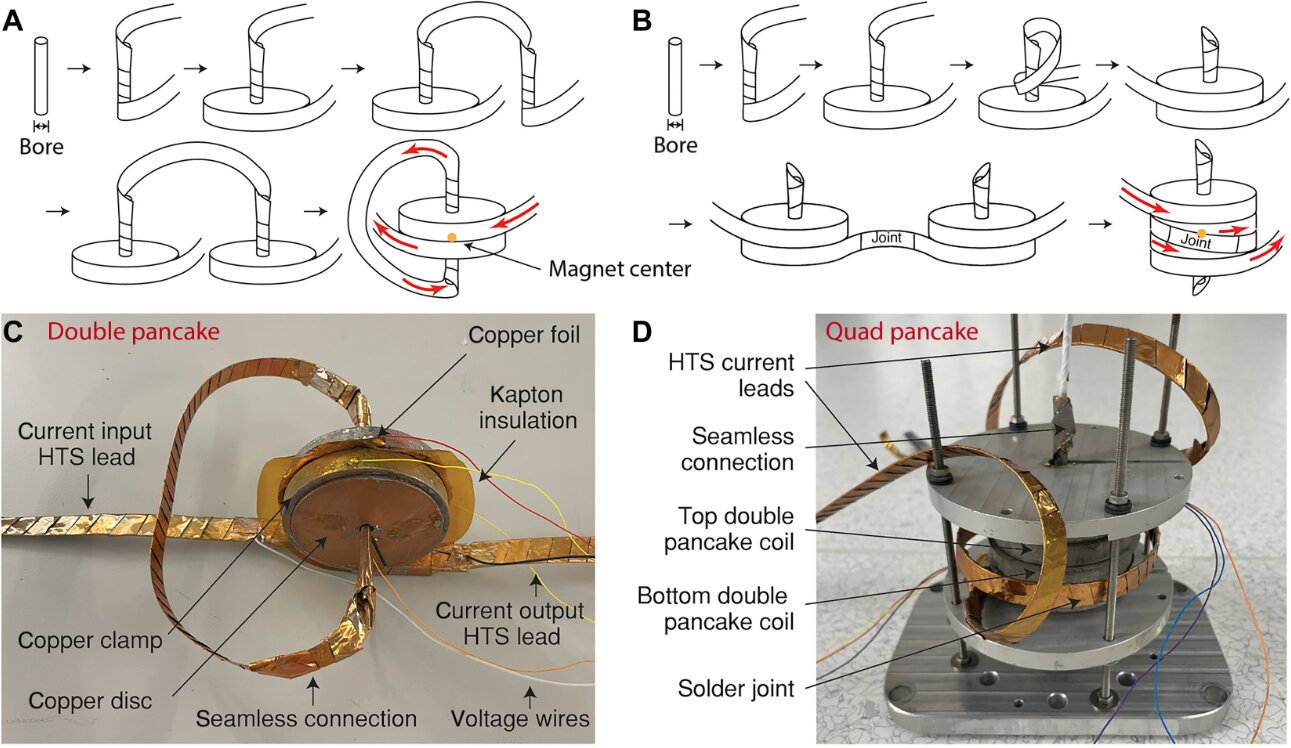
To get an extremely small bore diameter (3.1 millimeters=the width of a standard pencil), the team had to wind 12-millimeter-wide tape around a mandrel so small that traditional seamless coil designs wouldn’t work.
The “seamless connection” problem, how to join pancake coils without introducing resistance-creating joints, required completely novel winding methods.
I read through the paper twice before I actually understood what they’d done. They wound the tape starting from the middle, created two separate coil halves on different mandrels, then stacked them together and soldered the entire assembly. For the quad coil (four pancake layers), they stacked two double-pancake units and reinforced the connection with additional tape and solder.
This description might seem like technical minutiae. But it’s actually the difference between “we made a strong magnet” and “we made a strong magnet that consumes less than 1 watt of power”.
Power… is the word that keeps bouncing in my head as I read deeper.
The Physics of Holding 40 Tesla in the Palm of Your Hand
Here’s where my mind genuinely started to warp around what these researchers have accomplished.
The large hybrid magnets that currently hold the world record, 45.5 Tesla, achieved a few years ago, consume over 20 megawatts of power. That’s roughly the electrical consumption of 20,000 homes. They generate enough heat to melt most materials. They require constant cryogenic cooling from industrial-scale liquid helium systems.
These 40+ Tesla hand-held magnets require less than 1 watt, can you even beat that!
That difference isn’t just an engineering optimization, it’s a phase transition. It’s the difference between a technology that could only exist in major research institutions and a technology that could exist anywhere.
Think about what we use 1 watt of power for. Your phone’s charging port draws more power. A small LED uses about that much. A single hearing aid battery can power these magnets for years.
This is the moment where I start thinking like a sci-fi author, because the implications begin to spiral.
If you can make a 42 Tesla magnet that consumes less power than a watch, what does that unlock?

How Palm-Sized Magnets Could Transform NMR Spectroscopy
The immediate application outlined in the research is compelling enough, nuclear magnetic resonance (NMR) spectroscopy.
NMR is how chemists and biochemists determine molecular structure. It’s how we understand protein folding, how we design drugs, how we detect contaminants and how we analyze complex chemical systems.
Currently, NMR spectroscopy requires expensive, bulky machines housed in specialized laboratories. A good NMR spectrometer costs hundreds of thousands of dollars and needs a dedicated building wing, climate control, and expert technicians.
What if you could do NMR analysis on a tabletop? Or, more radically, bring it to the sample instead of bringing the sample to the machine?
The researchers actually tested this. They built a custom transmission line NMR probe small enough to fit inside that 3.1-millimeter bore and performed proton NMR experiments directly inside the magnet at 14 and 20 Tesla. The experiments worked and the signals were clear. The limitations were mostly engineering-related, the signal broadened due to magnetic field inhomogeneity, but that’s solvable.
In a reference to Star Trek, I found myself thinking about Spock’s tricorder, the handheld device that could instantly diagnose diseases, analyze molecular composition, and tell you everything about your environment. For decades, that seemed impossible. Now we have MRI machines that do something remarkably similar, but they’re building-sized and expensive.
- What if that trickled down?
- What if hospitals could have portable, ultra-high-field NMR scanners?
- What if pharmaceutical labs could perform on-site analysis instead of sending samples to centralized facilities?
- What if we could bring the science to the problem, rather than moving mountains to reach the science?
The researchers’ work doesn’t directly solve all of these problems. But it removes one of the fundamental barriers, which is, the assumption that you need a room-sized magnet.
The Democratization of High-Field Magnetic Technology
This one phrase in the paper:
“compact all-HTS magnets to enable widely accessible high-field NMR and other applications”.
Means, it’ll be widely accessible!
That’s not the language of incremental progress, it’s the language of paradigm shift.
Think about the history of transformative technologies. Computers were room-sized before they were desk-sized before they were pocket-sized. Telecommunications were institution-bound before they were consumer devices. Medical imaging went from stationary machines to portable ultrasound devices. Each shrinking represented not just engineering progress but a fundamental democratization of capability.
We’re watching that process happen to superconducting magnets right now.
And the implications ripple outward in unexpected directions.
In materials science research, researchers could test samples in situ, seeing how materials behave under extreme magnetic fields in real-time, rather than collecting data from remote facilities. In fundamental physics, experiments that currently require resources from major national laboratories might become feasible in university settings.
In medicine, and here I’m speculating, but not unreasonably, portable high-field NMR could enable new diagnostic approaches. Not quite Star Trek tricorder level, but approaching it.
In industry, quality control for materials and pharmaceuticals could accelerate. Portable analysis beats centralized bottlenecks.
These aren’t wild speculations. They’re straightforward extrapolations of what becomes possible when a fundamental constraint, size and power consumption, is removed.
From Iron Man’s Arc Reactor to Real-World Magnets
I keep circling back to Iron Man because the parallel is oddly perfect.
Tony Stark’s arc reactor is a miniaturized fusion power source. The narrative trick is that it’s impossibly compact while being impossibly powerful. The audience accepts this because the film has already established that Stark is brilliant in a way that defies normal engineering constraints.
The 40 Tesla magnets aren’t quite that metaphorical hand-wave. They’re not violating physics, they’re elegantly respecting it. But the end result feels similar:
impossible power in an impossible form factor.
The difference is that these magnets are real, they work. The team published the exact specifications, the winding procedures, the test results. Anyone with the expertise and resources could reproduce them.
That’s more impressive than fiction to me. The moment innovation becomes reproducible, it becomes transformative.

Takeaway
The thing that genuinely fascinates me about this research is what it reveals about the nature of technological progress.
We spent decades assuming that superconducting magnets were inherently large because high magnetic fields require lots of material. That assumption was reasonable. It was also wrong, or at least, incomplete. The right combination of material science (REBCO tape), clever engineering (no-insulation winding), and novel geometry (external seamless connections) could crack that assumption open.
How many other limits in technology do we assume are real, when they’re actually just the result of how we’ve solved problems in the past?
I think about particle physics. The large hadron collider uses superconducting magnets because it needs to bend particle beams at extreme energies. What if the next generation of fundamental physics experiments could be done with smaller, more portable magnet systems? Would that democratize particle physics in some way?
Frequently Asked Questions
1. What makes the 40 Tesla miniature magnet a “breakthrough” compared to standard MRI magnets?
Traditional 40+ Tesla magnets are room-sized, consume megawatts of power (enough for thousands of homes), and cost millions. The ETH Zürich breakthrough, led by Alexander B. Barnes, fits in the palm of your hand and consumes less than 1 watt. This shift from “industrial infrastructure” to “handheld device” represents a phase transition in accessibility for high-field science.
2. How does a magnet smaller than a pencil reach 42 Tesla without melting?
The secret lies in REBCO (Rare-earth barium copper oxide) high-temperature superconducting tape and a “no-insulation” (NI) winding technique. By removing traditional insulation, the researchers increased current density to over 2200 A/mm². Because there is zero electrical resistance at cryogenic temperatures (4.2 K), the magnet generates virtually no heat, allowing it to maintain record-breaking fields in a tiny 3.1 mm bore.
3. Will this technology lead to a “Star Trek Tricorder” for medical diagnostics?
While we aren’t at the “instant scan” level yet, these magnets enable portable high-field NMR (Nuclear Magnetic Resonance). This allows for chemical and molecular analysis on a tabletop rather than in a dedicated laboratory wing. It brings us one step closer to point-of-care molecular diagnostics, where a handheld device could identify complex proteins or drug contaminants in seconds.
4. Can these miniature magnets be used for full-body MRI scans?
Currently, no. The “bore” (the opening where the sample goes) is only 3.1 millimeters wide, about the size of a pencil lead. These are designed for spectroscopy (analyzing molecules) rather than imaging (looking at organs). However, the engineering principles, specifically the HTS tape and seamless winding, provide the blueprint for future portable MRI systems with larger bores.
5. Why do these magnets still require liquid helium if they are “high-temperature” superconductors?
“High-temperature” is a relative term in physics. While REBCO can superconduct at higher temperatures than traditional materials, reaching ultra-high fields like 42 Tesla requires the stability and current-carrying capacity found at 4.2 Kelvin (liquid helium temperature). However, because the magnets are so small, they require a fraction of the coolant used by hospital MRIs.
6. What are the primary applications for handheld 40T magnets in industry?
- Pharmaceuticals: Rapid, on-site verification of molecular structures during drug synthesis.
- Materials Science: Testing how new quantum materials behave under extreme magnetic fields without a trip to a national lab.
- Chemistry: Real-time monitoring of chemical reactions in small-scale flow reactors.
7. Is the 42 Tesla record the absolute limit for miniature magnets?
According to the Gao et al. (2026) research, this is just the beginning. The team has already proposed designs for 50 Tesla and beyond. As HTS tape becomes thinner and stronger, the limit will likely be determined by the mechanical strength of the materials, the “Lorentz forces”, rather than the physics of superconductivity itself.
Source: The research described here is based on the paper “40 Tesla miniature magnets” by Gao et al., published in Science Advances, March 2026. The full text includes extensive technical details, supplementary data, and methodological information for readers interested in deeper exploration.