The universe is about 13.77 billion years old, so obviously the farthest thing we can see is 13.77 billion light-years away. Since light travels one light-year every year, that sounds like it should be correct.
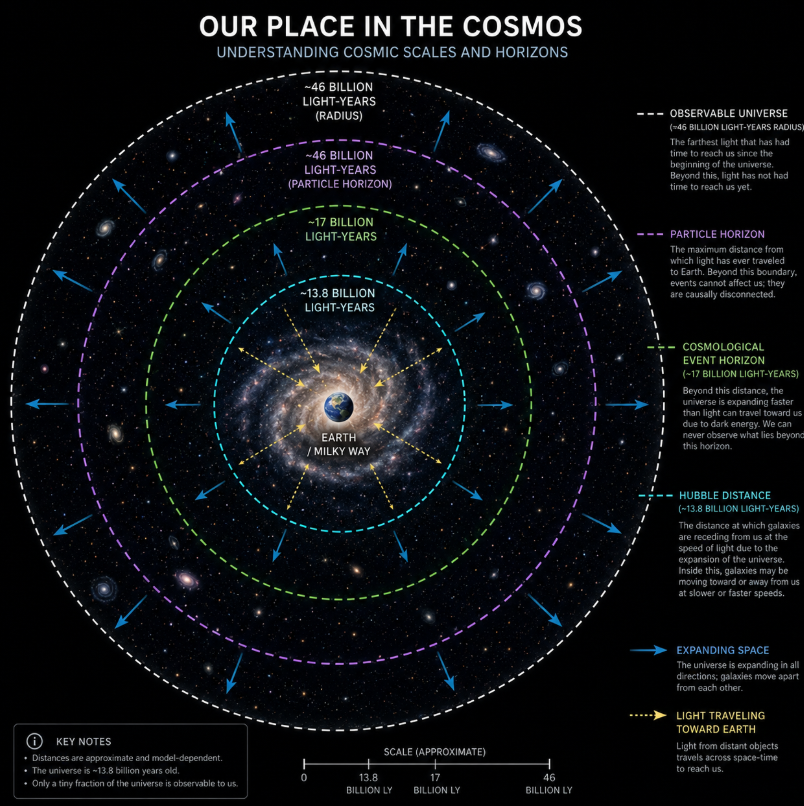
But it isn’t. The farthest objects we can see are actually about 45 billion light-years away. So the question comes, if the universe is only 13.77 billion years old, how can light from something 45 billion light-years away have reached us? It almost seems like the light must have traveled faster than it should.
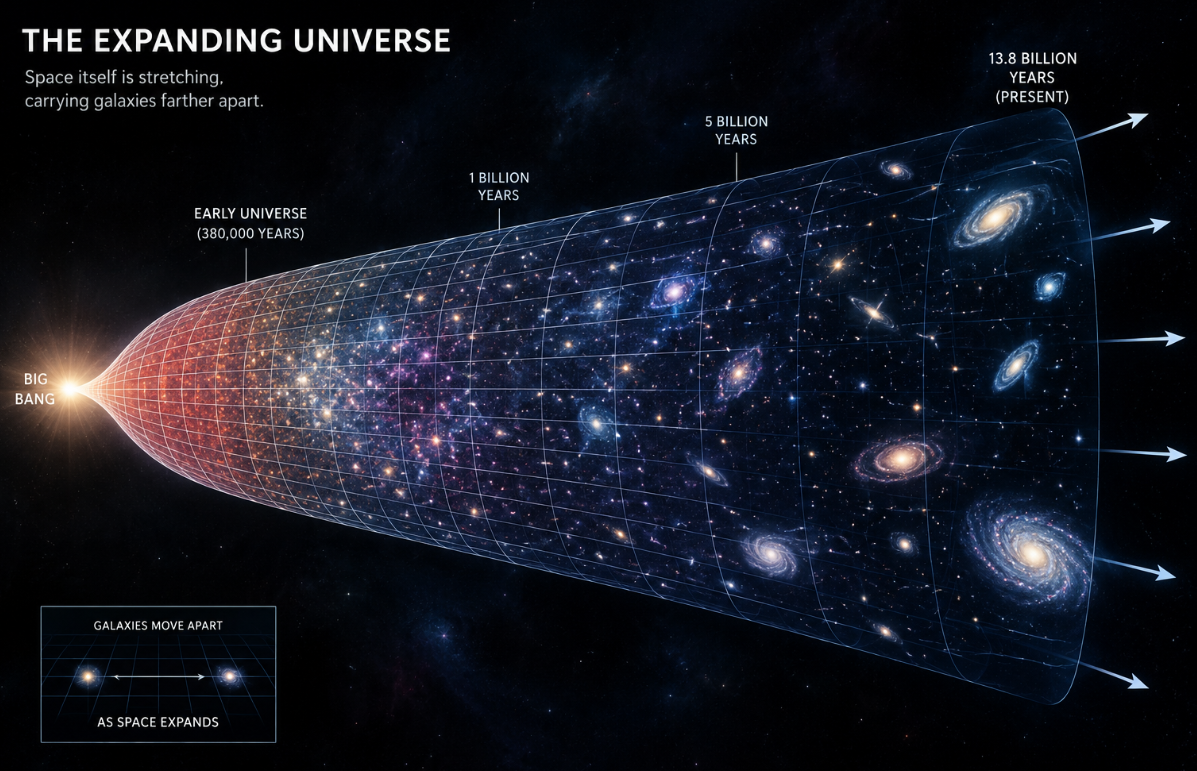
The answer is that the universe has been expanding the whole time the light was traveling. Space itself is getting bigger. So while the light was moving toward us, the distance between us and the place where the light came from also kept increasing. Because of this expansion, those objects are now much farther away than they were when they first sent out the light.
This idea can be hard to imagine, but it helps explain why we can see things that are much farther away than the age of the universe might suggest. It also leads to another interesting fact, as the universe keeps expanding, some galaxies will eventually become so far away that their light will never be able to reach us. In the distant future, much of the universe will slowly disappear from our view.
Let’s look at this step by step to understand how it all works.
The Universe Isn’t Just Big, It’s Growing
Imagine a loaf of raisin bread going into the oven. Before it bakes, the raisins are all close together. As the dough rises, every raisin moves away from every other raisin, not because the raisins are flying through the dough, but because the dough itself is expanding, carrying the raisins along with it.
That’s what’s happening with galaxies. Space itself is stretching, and galaxies are just along for the ride. Interestingly, it’s been confirmed observationally again and again since the 1920s, when Edwin Hubble first noticed that distant galaxies appeared to be moving away from us, and that the more distant a galaxy was, the faster it seemed to be receding.
Hubble figured this out through redshift. Light from a galaxy that’s moving away from us gets stretched out, shifted toward the red end of the spectrum. A simple way to understand this is to think about an ambulance siren. As the ambulance drives away, the sound becomes lower in pitch. Light behaves in a similar way, when a galaxy is moving away, its light gets stretched, making it appear redder.
The more redshift we see, the faster the galaxy is moving away from us. But when we look at galaxies that are billions of light-years away, things become more complicated. It is not just the galaxies moving through space. The space between us and those galaxies has also been expanding the entire time the light was traveling toward Earth. This expansion makes the galaxies appear much farther away than you might expect.
The Hubble Distance and the Event Horizon
Right now, the Hubble distance is about 13.77 billion light-years, which is almost the same as the age of the universe in years. This can make it seem like the two numbers are connected in some special way. However, they are not, they just happen to be very similar at this point in the universe’s history. It is simply a coincidence, not a hidden rule about how the universe works.
Galaxies that are farther away than the Hubble distance are moving away from us faster than the speed of light because space is expanding. At first, this might make you think we should not be able to see them at all. But that is not true.
We can still see many of these galaxies because the light we receive from them was sent out billions of years ago. At that time, the galaxies were much closer to us, and the space between us had not expanded as much. This gave the light enough time to begin its journey toward Earth.
So can we see everything, forever, if we just wait long enough? No. There’s a hard limit, called the cosmological event horizon, and it’s different from a black hole’s event horizon, even though the name invites confusion. The cosmological event horizon currently sits at roughly 17 billion light-years away. Any light emitted beyond that distance right now, in this instant, will never reach us. Not in a million years, not in a trillion. The expansion of space beyond that horizon is outrunning the light’s ability to close the gap, permanently.
And because dark energy is causing the expansion to accelerate, that event horizon isn’t static, it will keep growing, but only up to a point. Cosmologists calculate it’ll eventually plateau at around 60 billion light-years.
What Will the Universe Look Like in the Future?
If we think about what will happen in the future, the picture becomes even stranger. The universe is not just expanding, it is expanding faster over time. Due to which, galaxies that are already moving away from us will continue to get farther and farther away. The light they send toward us will also keep getting stretched, making it redder and weaker. After a while, that light will become so stretched that it will be almost impossible to detect.
If we move about 100 billion years into the future, the universe will look very different. By then, almost every galaxy outside our Local Group will have disappeared from view. The Local Group is a small collection of galaxies that includes the Milky Way, Andromeda, and a few dozen smaller galaxies that are held together by gravity.
If there are civilizations living that far in the future, they would not see the countless galaxies that we can see today. Future civilizations might not even have enough evidence to discover that the universe began with the Big Bang.
Scientists are also still trying to answer some important questions about how the universe expands. The current model of cosmology explains many observations very well, but it does not answer everything. For example, different ways of measuring the expansion of the universe give slightly different results. This problem is known as the Hubble tension. Scientists are also studying whether dark energy, which is thought to cause the universe’s expansion to speed up, has always stayed the same or has changed over time.
These questions do not change the basic idea of the observable universe or its horizons. However, they could change some of the exact numbers as scientists collect better data and improve their understanding of the universe.
The Takeaway
The observable universe is far larger than the universe’s age might suggest because the fabric of space has expanded throughout cosmic history. This expansion also means there is a limit to what we can ever observe. Beyond a certain point, galaxies are moving away so quickly that their light will never reach us, no matter how long we wait.
Right now, we live at a special time in the history of the universe. We can still see light from very distant galaxies, giving us clues about how the universe looked billions of years ago. In the far future, much of that evidence will disappear as the universe continues to expand. For now, though, we have a rare chance to study the universe’s past and learn how it has changed over time.
Frequently Asked Questions
How far away is the farthest galaxy we can see?
The farthest light we can observe comes from a distance of about 45 billion light-years. This is called the particle horizon, which marks the edge of the observable universe. Even though the universe is only about 13.77 billion years old, the expansion of space has stretched the distance between us and those distant objects over billions of years.
Is the universe expanding faster than the speed of light?
Yes, but this does not break the laws of physics. The rule that nothing can travel faster than light applies to objects moving through space. In this case, it is space itself that is expanding. Because of this expansion, very distant galaxies can move away from us faster than the speed of light without violating Einstein’s theory of relativity.
If the universe is only 13.77 billion years old, how can we see objects 45 billion light-years away?
The key is that 45 billion light-years is the galaxy’s current distance, not the distance the light traveled. When the light began its journey, the galaxy was much closer to us. While the light was traveling through space, the universe continued to expand, making the galaxy much farther away than it was when the light was first emitted.
Is this explanation based on accepted science?
Yes. These ideas are based on the Lambda Cold Dark Matter (ΛCDM) model, which is the standard model of cosmology used by scientists today. Although researchers are still studying questions about dark matter, dark energy, and the universe’s expansion, the basic ideas about the observable universe, cosmic expansion, and cosmic horizons are strongly supported by observations.