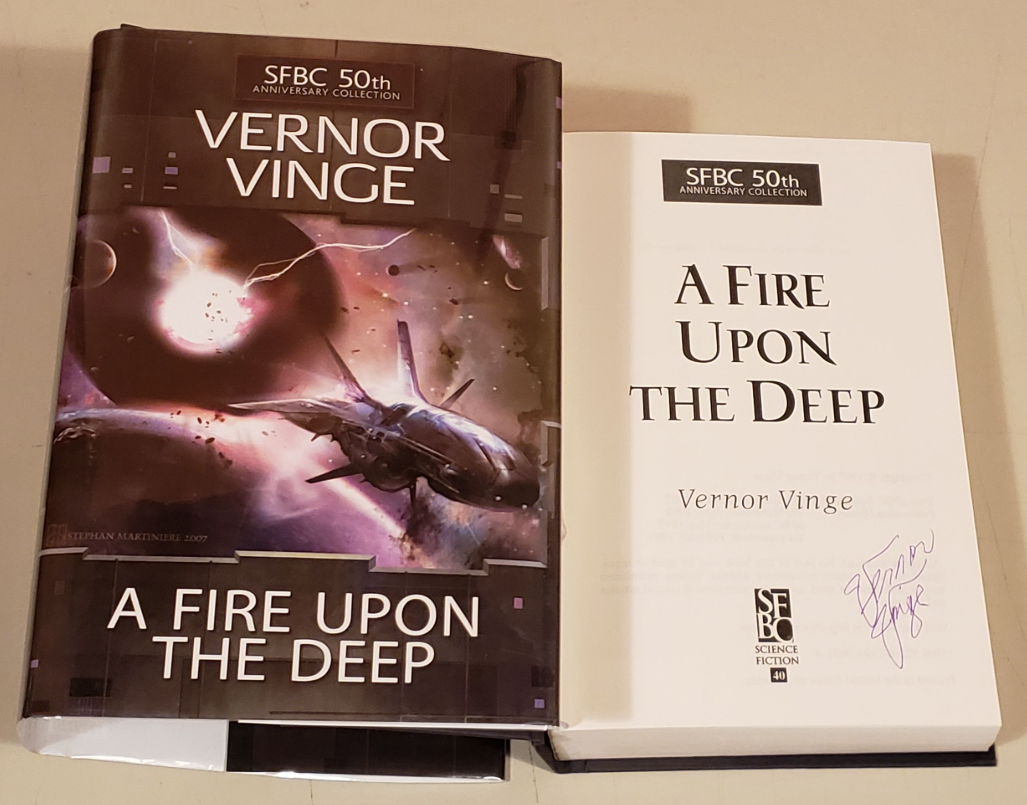
I was just thirty pages into Vernor Vinge’s A Fire Upon the Deep and I knew I’m gonna love this book.
I picked this novella expecting a standard space opera, perhaps some faster-than-light travel and a galactic empire in decline. Instead, I found a book that didn’t just invite me into a story, it invited me into a completely different way of thinking about space, time, intergalactic internet, different levels of thought and consciousness, and yes AI of course.
A Fire Upon the Deep was first published in 1992, and it won the Hugo Award in 1993. It was written by Vernor Steffen Vinge, who was an American science fiction writer and a professor. He taught math and computer science at San Diego State University. Vinge was one of the first people to popularize the idea of the technological singularity, and he also helped bring the idea of “cyberspace” into fiction. He won the Hugo Award for several of his works, including A Fire Upon the Deep (1992), A Deepness in the Sky (1999), and Rainbows End (2006), as well as shorter works like Fast Times at Fairmont High (2001) and The Cookie Monster (2004). (Details have been picked up from wikipedia)
Coming back to the book, I wonder why this novel isn’t cited as frequently as Dune or Foundation in mainstream circles.
It is, quite simply, one of the most underrated masterpieces in science fiction history. Vinge didn’t just write a plot, he engineered a cosmos. It is a book that feels as though it was written by someone who understands the sheer, terrifying scale of the universe and decided to make it our playground.
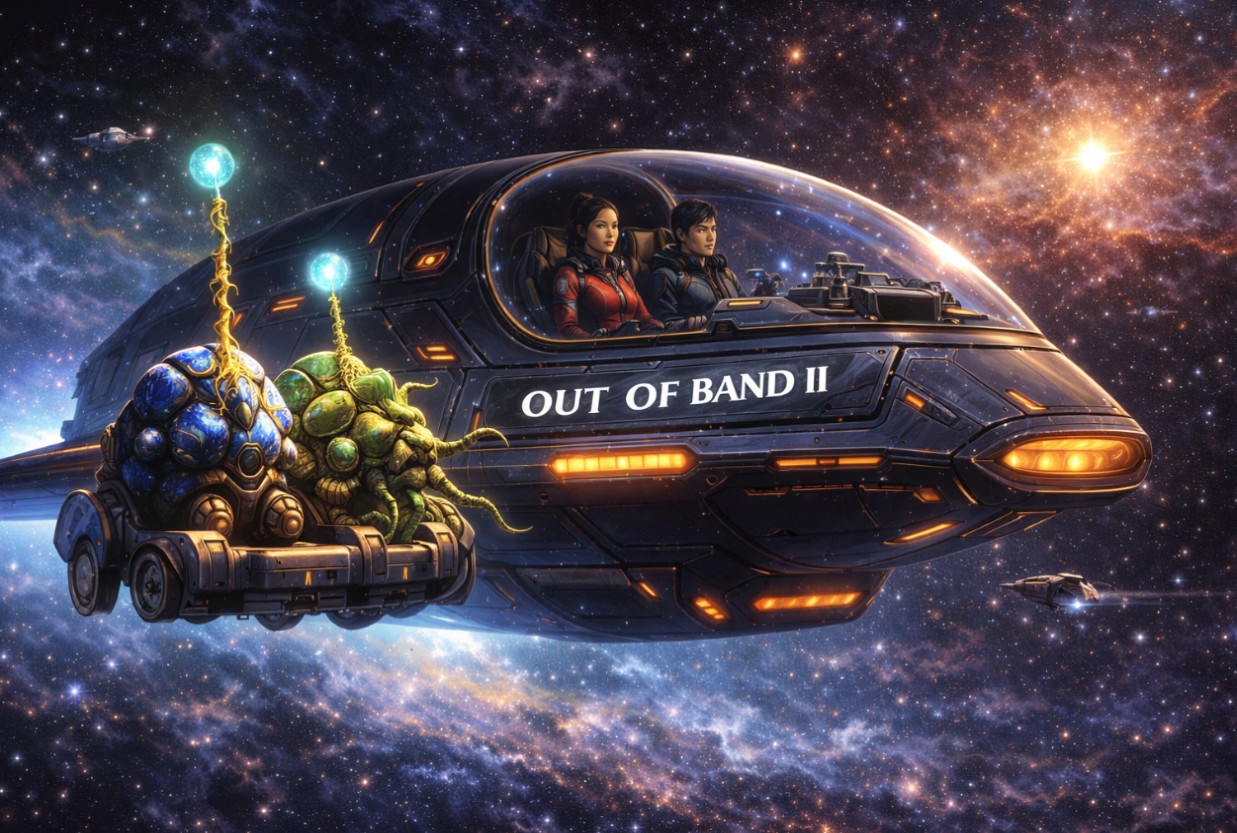
So… What Actually Happens in This Book?
A Fire Upon the Deep is a huge space adventure that takes place across an entire galaxy. The story begins when a group of human researchers from the Straumli Realm discover an ancient archive on a distant, abandoned planet. Unfortunately, they accidentally awaken something dangerous and a powerful super-intelligence called the Blight.
The Blight isn’t just smart, it’s almost godlike. It spreads quickly from star system to star system, destroying or enslaving entire civilizations. As chaos erupts, two children, Johanna and Jefri Olsndot, escape in a cargo ship filled with other kids in suspended sleep. Their ship crashes on a strange, medieval-style planet inhabited by alien creatures called the Tines.
The Tines are unlike any aliens you’ve seen before. Each “person” is actually a group of wolf-like creatures who think together as one mind. (There’s more about them written below).
On this planet, the children get caught in political struggles between rival Tine factions, some kind and some cruel.
Meanwhile, in a more advanced part of space called the Beyond, a small group is trying to stop the Blight. Ravna Bergsndot, a trader, and Pham Nuwen, a mysterious and powerful figure, travel in a patched-together spaceship. They use a galaxy-wide communication (inter galactic internet) network to search for help and plan their next moves, racing against time as the Blight continues to grow stronger.
The novel moves between these two storylines, the children struggling to survive on an alien world, and the spacefaring adults fighting a massive cosmic threat. There are space battles, dangerous jumps between star systems, references to different zones of thoughts, cognitive residue (dreams, intuition maybe) and tense moments where entire civilizations hang in the balance. From the very first pages, the story moves quickly, mixing big action scenes with thoughtful ideas about intelligence, technology, aliens, and survival.
The Galaxy Isn’t Flat, It’s Stratified
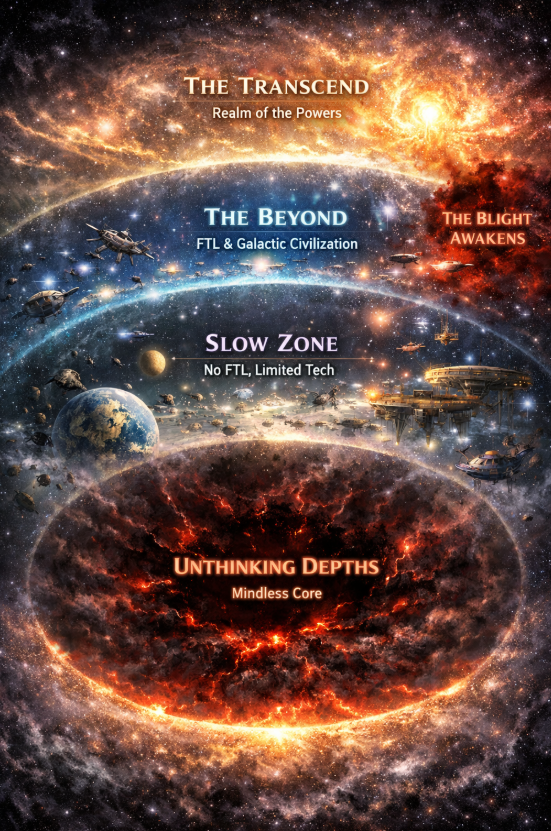
The central conceit of the novel is the Zones of Thought. It’s like imagining that our galaxy is not a uniform vacuum, but as a layered ocean (as depicted in image above, created from chatgpt). Near the dense galactic core lies the Unthinking Depths, where even the simplest biological intelligence struggles to function. Moving outward, we find the Slow Zone, the Earth, where the laws of physics are stubborn, and the speed of light is still a mystery.
But as you move toward the galactic rim, you enter the Beyond. Here, the “constant” of light speed loosens its grip. Computation becomes more efficient, artificial intelligence can transcend human limits. Beyond that lies the Transcend, a realm inhabited by “Powers”, entities so advanced they are essentially gods, though they often “Archive” themselves or vanish into states of being we cannot comprehend.
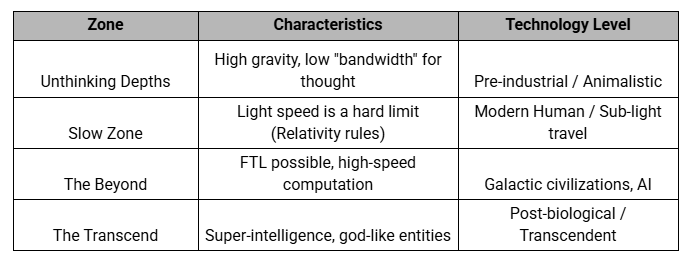
This is creative thinking at its best, it’s a profound metaphor for the limits of our own perception. We often assume that the laws of physics are universal truths, but Vinge asks:
What if they are just local conditions?
It’s a concept that echoes the cosmic scale of Arthur C. Clarke’s Childhood’s End, where humanity is merely a larval stage for something greater, but Vinge grounds it in a technical rigor that would make Isaac Asimov nod in approval.
If Asimov gave us the grand sweep of history and Clarke gave us the majesty of the unknown, Vinge gives us the mechanics of wonder.
He explains why the universe is the way it is, and then he breaks those rules to show us what lies beyond. It’s a bit like H.G. Wells’ The Time Machine, but instead of traveling through time, we are traveling through the very capacity for thought.
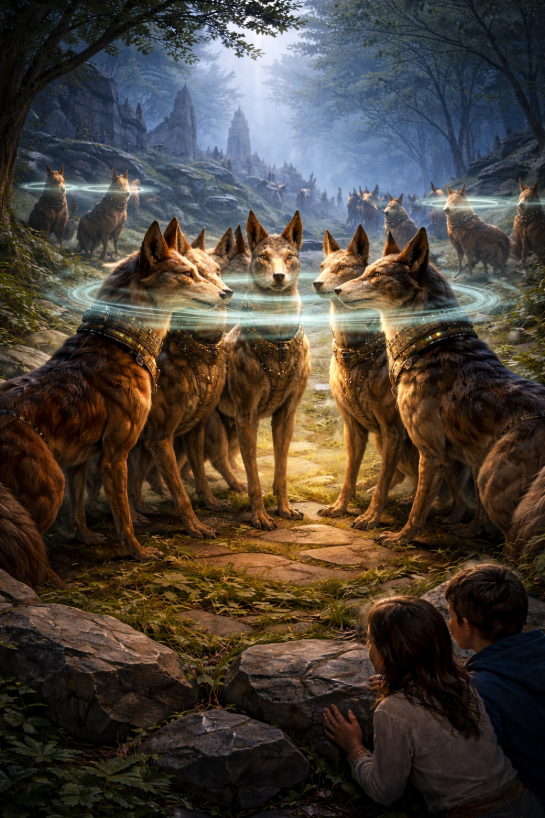
The Strangest Thought Experiment About Consciousness I’ve Ever Read
If the Zones are the “where”, the Tines are the “who”, and they are perhaps the most inventive alien race ever put to paper.
Imagine a creature that looks like a long-necked wolf. Individually, it is little more than a clever animal. But the Tines communicate via high-frequency sound, a biological “local area network”. When four to six of these creatures stand near each other, their thoughts mesh. They form a single, coherent personality.
This means, here consciousness works together and forms a coherent whole, a “person” is a pack. If one member of the pack dies, the person loses a “part” of their memory or personality but survives, slowly integrating a new pup to regain their full self. It’s a hauntingly beautiful depiction of identity that rivals the sociological depth of Ursula K. Le Guin’s City of Illusions.
Vinge explores the “human-like imperfections” of this existence with startling clarity. He gives an instance when two packs get too close, their thoughts blur. It’s called “soul-noise”, a chaotic overlap of identity that is as terrifying to them as it is fascinating to us.
Through the Tines, Vinge forces us to confront our own “singleton” nature. Are we truly individuals, or just a collection of competing impulses that happen to share a single brain?
This focus on the “other” and the nature of consciousness is where Vinge draws closest to Ursula K. Le Guin. Like her Left Hand of Darkness, A Fire Upon the Deep is a thought experiment about how different biological realities create different social structures.
The Tines’ medieval society is shaped entirely by their biology, their wars are fought not just with swords, but with “sound-noise” designed to disrupt the enemy’s consciousness. It’s a brilliant, and highlights how clever and intense this idea is, making you see what it’s like to be part of a close-knit pack, something that feels strange and unfamiliar, but also very familiar and human at the same time.
The Internet Before the Internet
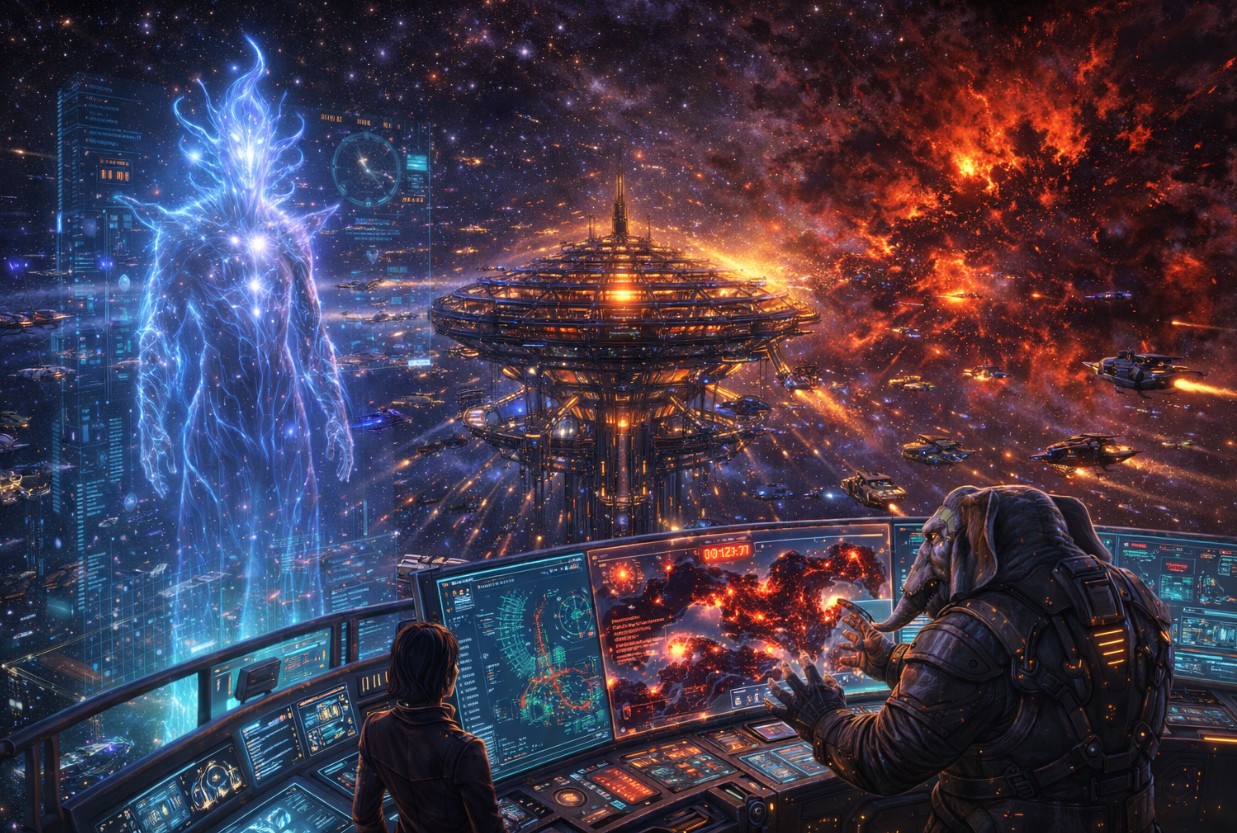
Long before the internet became noisy and chaotic, Vinge imagined something called the Known Net, a kind of space version of online discussion groups like Usenet. Since space is huge, talking between different star systems usually means sending simple text messages that can take many months or even years to arrive.
The result is a “Net of a Million Lies”, where propaganda, conspiracy theories, and genuine pleas for help all look the same. It feels like it was predicting today’s online environment. When you read these parts now, you notice they captured how our digital age works, with so much info coming from everywhere at once, making everything feel urgent and intense, even when the people involved are very far apart in space.
Vinge’s treatment of information is as sharp as Kurt Vonnegut’s satire, but with a more earnest curiosity. He shows us how a “Blight”, a malevolent super-intelligence, can use the Net to subvert entire civilizations, not through brute force, but through the slow, insidious spread of data.
It’s a warning that feels more relevant in 2026 than it did in 1992. It reminds me of José Saramago’s Blindness, where a single event cascades through a society, but here the “blindness” is the inability to distinguish truth from noise in a galaxy-spanning network.
Takeaway
A Fire Upon the Deep is a bridge between the Hard SF of Arthur C. Clarke and the New Wave sensibilities of writers like Kazuo Ishiguro or Kurt Vonnegut. It has the epic, inventive scale of Cixin Liu’s Three-Body Problem, but with a warmth and character-driven focus that Liu sometimes lacks. While Liu’s work often feels like a grand, cold equation, Vinge’s work is a vibrant, breathing ecosystem.
When you read Vinge, you aren’t just being told a story about a “Blight” (a malevolent super-intelligence) threatening the galaxy. You are being taught to look at the stars with a renewed sense of wonder. You start to wonder about the “physics of curiosity”. You begin to see how relativity isn’t just a hurdle for space travel, but a fundamental part of our existence.
This is where the book truly shines as an educational tool. It inspires a deep, abiding curiosity about the world around us. It makes you want to understand the speed of light, the nature of gravity, levels of thoughts or consciousness and the limits of computation. It’s the kind of book that makes you want to be a scientist, or at the very least, a more informed citizen of the universe. And these are all the reasons why I thoroughly loved this book.
If you’ve ever felt that modern sci-fi has become too small, or too focused on the immediate and the mundane, this is the antidote.
It is a book that demands you think big.
Although, it has its own imperfections, like sometimes the technical jargon can feel like a steep climb, and the sheer number of alien names can be a lot to juggle. But these aren’t flaws, they are the texture of a lived-in universe.
I’d like to add, science fiction at its best doesn’t just predict the future, it expands the present. A Fire Upon the Deep did that for me. It made my world feel stranger and infinitely more interesting. It’s an enthusiastic recommendation from a reader who has spent a lifetime looking for the next great frontier. You’ll find it here, just beyond the Beyond.
Huge shout-out to Open Library for providing the book online.