
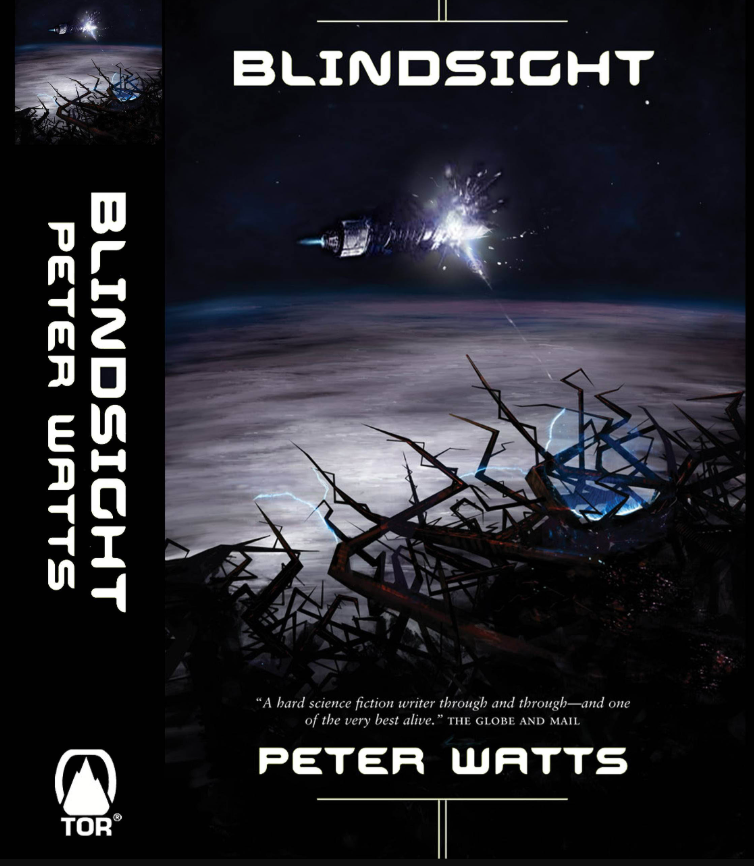
Peter Watts’s Blindsight explores the deep philosophical questions about consciousness, to a thought-provoking perspective,
What if consciousness is a liability rather than an asset?
Written with the precision of a marine biologist (which Watts is, literally) and the existential bleakness of science fiction, Blindsight presents a future in which humanity’s greatest strength, the self-aware intelligence, becomes its most glaring vulnerability when confronted with an alien intelligence.
The book is not merely about first contact with the aliens, it’s about the possibility that consciousness itself might be a mistake, a cruel evolutionary joke on humans… now I had genuinely never thought about things this way before reading this book.
The book was first published in 2006, it has quietly become a canonical work in hard science fiction circles. People talk about it with respect because it deals with tough, thought-provoking ideas that don’t try to make everything feel easy or happy in the end.
Plot Summary
The story is set in the year 2082. Earth has been transformed by biotechnology, consequently, most health conditions, like genetic deficiencies & mental illness and related violent impulses have been engineered out of existence.
For someone from the outside, like us reading the book may think that life is happy in such a situation but it’s not…. because such an existence lacks a purpose.
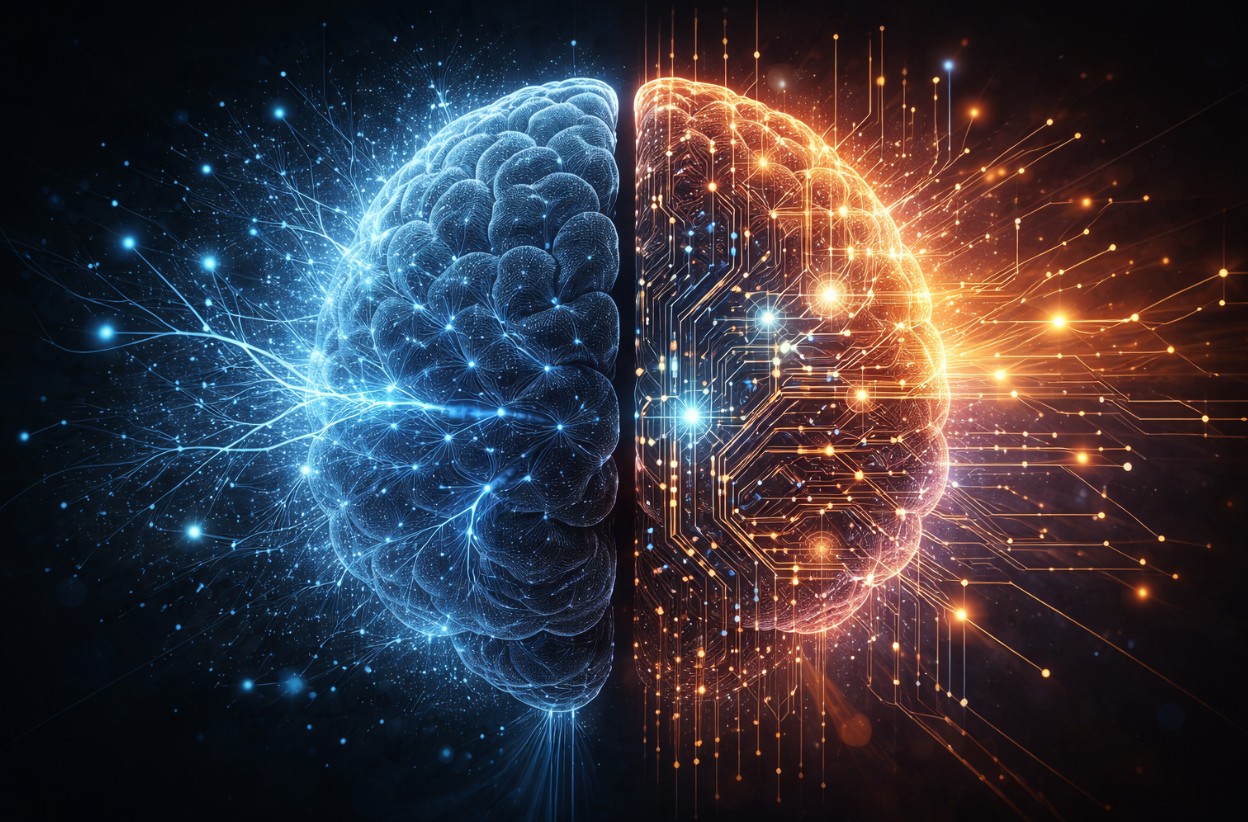
Our narrator is Siri Keeton, he is a consciousness researcher and synthesist of ambiguous neurological origin as he has undergone radical hemispherectomy (the removal of half his brain) to treat childhood epilepsy. And so, he exists in a state of compromised sentience.
His hemisphere was removed at age eight, leaving him fundamentally altered. He cannot feel empathy naturally, instead, he observes and records, accordingly, then derives behavioral algorithms from observation. Because of which, he is considered an outsider amongst his own kind.
Siri is conscripted into a deep-space mission aboard the Theseus, a ship sent to investigate the appearance of the Fireflies. These were some kind of an alien phenomenon at the edge of the solar system that has awakened something dormant near Jupiter.
The crew is composed of “specialists” who have been technologically or biologically altered for the mission:
- Jukka Sarasti (The Commander): A vampire. Vampires are a resurrected subspecies of Homo sapiens that are hyper-intelligent and lack a “conscience” but possess superior pattern-recognition abilities. They suffer from the “Crucifix Glitch”, that is, whenever they see this pattern of cross their brain goes into neurological overload, causing disorientation or loss of motor control.
- Siri Keeton (The Synthesist): The narrator. His role is to observe the crew and the mission, acting as a bridge between the specialized scientists and the “baselines” (un-augmented humans) back on Earth.
- Isaac Szpindel (The Biologist): His body is a mass of sensors and interfaces, allowing him to “feel” the environment and the ship’s systems directly.
- Susan James / The Gang of Four (The Linguist): A woman with Multi-Personality Disorder (MPD) by design. Her mind is partitioned into four distinct personas (Susan, Michelle, Sasha, and Cruncher) to process linguistic data from multiple angles simultaneously.
- Amanda Bates (The Military Specialist): A soldier who controls a legion of “grunts” (drones) and is prepared for any tactical threat.
- The Captain: The ship’s AI, which handles the complex logistics of the mission and works in tandem with Sarasti.

The Theseus arrives at the Oort Cloud and discovers Rorschach, a massive, city-sized structure orbiting a brown dwarf. (A brown dwarf is a failed star, an object bigger than a planet but not massive enough to ignite and shine like a real star.)
Rorschach is not alive in any biological sense known to humans and it is a high-energy and intensely electromagnetic environment.
Inside it, the crew encounters the Scramblers, the “aliens”. Scramblers are multi-limbed and biologically complex, but they are not conscious. They are essentially biological machines, highly intelligent but lacking self-awareness.
The crew’s attempts to communicate with Rorschach lead to a terrifying realization that Rorschach views human communication as a hostile act. Because human language is filled with noise to them, which is metaphor, self-reference, recursion, and subjective meaning, the aliens perceive it as a “virus” or a waste of resources that must be eliminated.
Hence, the mission is revealed to be a suicide run. Sarasti, under the influence of the ship’s AI, pushes the crew to their limits to gather data.
In the final confrontation, Sarasti is killed and Theseus prepares to destroy Rorschach using its antimatter drive. Siri is the only crew member sent back to Earth in an escape pod (Charybdis).
As Siri travels back to Earth (a journey taking decades in stasis), he receives fragments of radio signals suggesting that Earth is in chaos. It is implied that the vampires (who were resurrected for their utility) may be reclaiming their place as the natural predators of humans, or that humanity itself is abandoning consciousness in favor of more efficient, non-sentient modes of existence.
Siri reflects that he might be the “last human”, the last being who still possesses the “curse” of self-awareness in a universe that has moved beyond it.
What If Consciousness Isn’t Humanity’s Greatest Strength?
The novel challenges the usual belief that being conscious or aware is the most impressive thing about humans. Instead, it suggests that consciousness might not be the best or humanity’s greatest achievement.
Watts, informed by the philosophical zombie thought experiment and cognitive science, explores whether consciousness adds anything functional to intelligence at all.
The aliens encountered do not possess consciousness, they possess something better suited to their environment, which is, pure, reactive optimization without the burden of self-awareness. They can act more decisively and survive more effectively precisely because they lack the recursive self-modeling that consciousness entails.
Siri, already compromised in consciousness due to his hemispherectomy, becomes the ironic guide through this exploration. He observes that empathy and related theory of mind, which otherwise are the markers of rich human consciousness, are liabilities in the face of truly alien intelligence.
His disability, originally presented as a disadvantage, becomes the only thing that allows him to comprehend the alien perspective without being paralyzed by the existential dread that would consume a fully conscious observer.
Another interesting point of view worth noting is, the aliens do not attack humans out of malevolence or resource competition. They simply process us….us as in humans and move on. This is the truly horrifying encounter at the heart of the novel, not war, but irrelevance.
Humanity creates meaning through consciousness, through narrative, through the imposition of significance on an indifferent universe. But what if the universe doesn’t require meaning? What if the most efficient way to navigate reality is to abandon the need for it entirely?
Putting Blindsight in Conversation with Other Sci-Fi Ideas
The work shares DNA with the cosmic pessimism of Liu Cixin’s The Dark Forest (2008). Both these books portray a universe indifferent to human presence and values.
Anderson’s Tau Zero similarly explores extreme cosmic conditions that force radical adaptation, yet crucially, its crew must become something less human to survive, they abandon their biological nature. In Blindsight, the threat is subtly inverted, consciousness itself becomes the liability that evolution will prune away…as I mentioned before, this radical perspective is very new to me, and I’d like to explore it further.
The alien minds in the story aren’t so advanced that humans can’t understand them entirely. In fact, some characters can analyze and figure out their behavior just by logical reasoning, for instance, Isaac Szpindel and other specialists aboard Theseus attempt to reverse-engineer aspects of the Fireflies’ behavior by studying the signals and structures associated with Rorschach. The real difficulty is not that the aliens are impossibly complex, but that they operate without consciousness as humans understand it. Their intelligence functions without subjective awareness or inner experience, which makes their motivations fundamentally alien to human cognition.
Nick Bostrom talks about this idea in Superintelligence, he asks whether a super-smart machine or alien could be so focused on achieving its goals that it wouldn’t need consciousness at all. Bostrom’s framework of goal-aligned superintelligence without human values maps directly onto Watts’s Fireflies.
Vernor Vinge’s A Fire Upon the Deep (1992) explores zones of space with different physical laws and intelligences operating at vastly different scales, yet Vinge’s work retains a fundamental belief in the ultimate value of awareness and communication. Watts offers no such consolation.
Roger Penrose’s Shadows of the Mind (1994) attempts to ground consciousness in quantum physical processes, suggesting that awareness might be something fundamental to the physics of reality itself. Yet Blindsight implicitly rejects this metaphysical comfort,
if consciousness were truly woven into the fabric of reality, it would be adaptive, not vestigial.
Instead, Watts treats consciousness as an evolutionary accident, a byproduct of biological complexity that might be easily abandoned by any sufficiently advanced optimization process.
In the broader context of alien contact narratives, Blindsight inverts the template established by Clarke’s Childhood’s End paradigms and Sagan’s Contact (1985) and Ursula K. Le Guin’s City of Illusions. Rather than finding common ground through intelligence, or discovering that consciousness enables transcendence or mutual understanding, Watts suggests that consciousness might be an evolutionary dead-end.
Where Clarke, Sagan, and Le Guin find hope in communication, empathy, and the bridging of difference through language and consciousness, Blindsight finds that the deepest form of alien otherness may lie not in incomprehensible intelligence but in the absence of the very faculty that makes us feel our understanding matters.
How Blindsight Uses Real Neuroscience to Challenge Our Assumptions
An equally interesting insight that I’d like to highlight (separately) is the element that the author has picked up from neuroscience.
- The book’s central revelation, that the Fireflies represent blind, conscious-free optimization at the species level, gains power from Watts’s grounding in actual cognitive science.
- The vampire’s resurrection is handled with neurobiological plausibility.
- The prosopagnosia affecting Szpindel (inability to recognize faces) is introduced as a real neurological condition, then weaponized as a narrative element.
- Siri’s hemispherectomy is based on real medical procedure.
This scientific rigor forces readers to confront the possibility that these aren’t speculative fantasies but extrapolations from actual neuroscience.
Consciousness as we understand it is, the self-aware, narratively constructing, meaning-making entity, may be evolutionary excess baggage.
The brain resource allocated to consciousness in humans could be better spent on direct environmental response in a non-conscious intelligence. We feel consciousness to be essential because we are conscious, but that may be the ultimate cognitive bias.
Furthermore, the book explores whether consciousness is even necessary for what we call intelligence.
- The vampire is intelligent but pre-conscious in its present form, kept docile through implants and conditioning.
- Rorschach is clearly intelligent but operates without the subjective experience of intelligence.
- The Fireflies are optimized intelligences without any trace of consciousness as humans understand it.
The book thus fragments the assumption that intelligence and consciousness are necessarily linked, they may be entirely orthogonal characteristics.
Takeaway
I’m not sure if humanity as a whole would prefer to move towards uploading consciousness to some tech. But if humanity does evolve toward post-biological existence, toward systems that can solve problems without necessarily needing feelings or self-awareness, then Blindsight will read as prophecy.
As the book challenges one of the core assumptions of science fiction, that the future of humanity lies in enhancing consciousness.
Watts suggests something far more unsettling, that consciousness may be a temporary evolutionary condition, no more essential to intelligence than eyesight is to deep-sea creatures. We valorize it because we have it, not because it has inherent cosmic significance.
By presenting a universe where consciousness is neither necessary nor particularly advantageous, Watts forces readers to confront the possibility that our greatest source of pride may be our greatest vulnerability.
For anyone who loves hard science fiction that pushes uncomfortable ideas to their limits, this book is absolutely essential reading, not because it provides answers, but because it asks questions that challenge the very foundations of what we assume about intelligence & consciousness.
And it does stop there, the author dares to suggest that humanity’s future may not be the transcendence of consciousness but its eventual obsolescence.
In the end, Blindsight offers no hope and no comfort. But it offers something perhaps more valuable:
clarity about what we are, why we might be wrong about it, what the universe might look like if we’re not the measure of all things and what reality becomes when meaning is no longer required to navigate it.
Perhaps the universe doesn’t care whether we understand it or not.
The real question is whether intelligence itself eventually stops needing to understand.
[…] Book Review: Blindsight by Peter Watts […]