More than a decade back I got introduced to Dr. Brian Greene, a professor of physics and mathematics. He is well known for his groundbreaking discoveries in superstring theory. Some of his major contributions include the co-discovery of mirror symmetry and research on changes in the topology of space.
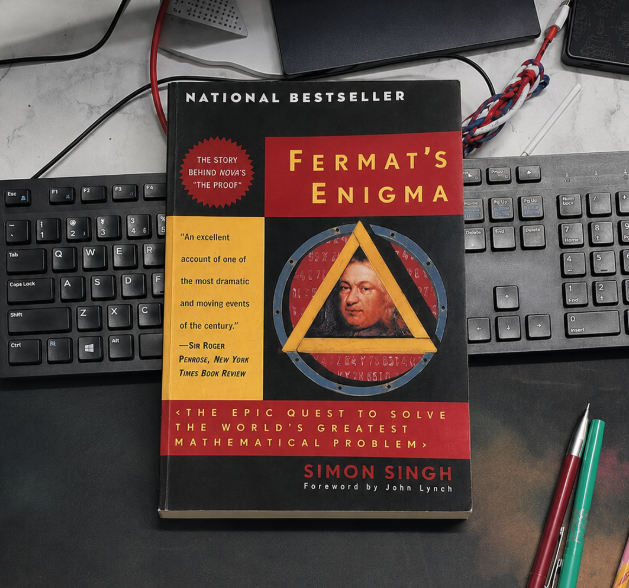
In one of his interviews he said that mathematics is the language for encapsulating the patterns of the universe that we observe. I found the idea quite profound and every time I read the works of Pickover the concept resonates and similar things come to mind recently when I was reading Simon Singh‘s Fermat’s Enigma. Fermat’s Last Theorem was first published in 1997.
It tells the story of a 17th-century mathematical conjecture, first proposed by Pierre de Fermat in 1637, that captivated and frustrated mathematicians for more than three centuries before it was finally proved.
Along the way, Singh weaves together Pythagoras’ obsession with whole numbers, Sophie Germain’s fight to even be allowed into the conversation, Gödel’s unsettling proof that some truths can never be proven, and Andrew Wiles’ decade of secret, solitary work in an attic.
By the end, Greene’s observation feels almost literal, watching mathematicians pursue a proof is, in many ways, watching them uncover the hidden patterns of the universe.
From Pythagoras to Andrew Wiles
The book begins in June 1993, when mathematician Andrew Wiles gives a lecture at the Isaac Newton Institute in Cambridge. At the end of the lecture, he announces that he has finally proved Fermat’s Last Theorem, a famous math problem that had remained unsolved for more than 350 years. This surprises the entire mathematical community.
The author then goes back in time to explain how Wiles became interested in the theorem when he was just ten years old after reading about it in a library book by E.T. Bell.
The chapter also explores the history behind the theorem by introducing Pythagoras. It describes his life, his secret society called the Brotherhood in Croton, and his belief that numbers could explain everything in the universe. The author explains Pythagoras’ famous theorem, the idea of perfect numbers, and how music and nature follow mathematical patterns.
Next, Singh explains the difference between scientific proof and mathematical proof. Scientific proof is based on evidence and can change if new evidence is found, while mathematical proof is based on logic and is considered absolutely true once proven. He uses the mutilated chessboard puzzle to show how mathematical reasoning works.
Now, let’s talk about the problem and its solution as discussed in the book.
Pythagoras discovered that for right-angled triangles,
x^2 + y^2 = z^2
Fermat changed the equation to something interesting, he claimed,
Once the exponent is greater than 2, you’ll never find three non-zero whole numbers that make the equation true.
Although he wrote that he had a proof, he never showed it, leaving mathematicians with a mystery that lasted for centuries, which became known as Fermat’s Last Theorem.
Getting to Know Pierre de Fermat
Before we go further, let’s talk about Pierre de Fermat. The second chapter is dedicated to his history.
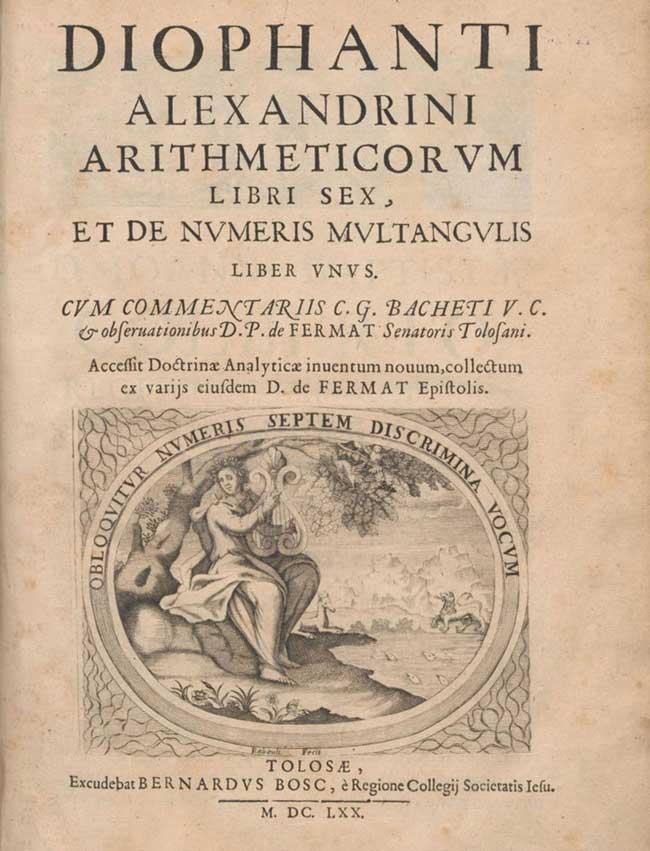
Pierre de Fermat was a French lawyer and mathematician who lived in the 17th century. Even though mathematics was only his hobby, he lived in Toulouse and mostly taught himself by reading a Latin version of Arithmetica by Diophantus. Fermat did not like publishing his work. Instead, he enjoyed giving difficult math problems to other mathematicians like Descartes and Wallis to solve.
The chapter also explains that Fermat worked with Pascal to help create probability theory and made important contributions to the early ideas of calculus. It then looks at the history of number theory, starting with Euclid and the Library of Alexandria, continuing through the Dark Ages, and ending with the rediscovery of ancient mathematical books. When Arithmetica was published during Fermat’s lifetime, it inspired many of his discoveries.
The most famous part of the chapter is about a note Fermat wrote in the margin of his copy of Arithmetica in 1637. He claimed that he had a wonderful proof for a mathematical statement, but said the margin was too small to write it down. (The one I’ve mentioned in the previous section.)
The Race to Solve Fermat’s Last Theorem
Chapters 3 and 4 describe the many failed attempts to prove Fermat’s Last Theorem over the next few centuries. Leonhard Euler successfully proved the theorem for the case where (n = 3), but his method could not be used for all values of (n). Mathematicians later realized they only needed to prove the theorem for prime numbers, but since there are infinitely many primes, the problem remained extremely difficult. The chapter also explains how prime numbers became important in modern cryptography and even in nature, where cicadas use prime-number life cycles to avoid predators. It also tells the story of Sophie Germain, who had to study mathematics under a man’s name because women were not accepted in the field. Her ideas helped prove several more cases of the theorem. However, hopes were crushed when Ernst Kummer discovered serious flaws in the proofs of Gabriel Lamé and Augustin Cauchy, making many mathematicians believe the theorem might never be solved.
Chapter 4 focuses on new developments in mathematics during the early 1900s. It begins with Paul Wolfskehl, whose interest in Fermat’s Last Theorem changed his life and led him to offer a large cash prize for a correct proof. This attracted many amateur mathematicians, but none succeeded. The chapter also discusses David Hilbert’s plan to build mathematics on a solid logical foundation, Bertrand Russell’s paradox, and Kurt Gödel’s incompleteness theorems, which showed that some true mathematical statements can never be proved. This raised doubts about whether Fermat’s Last Theorem could ever be proven.
Later, World War II and the invention of computers allowed mathematicians to test the theorem for many values of (n), but checking examples could never replace a complete proof. The chapter ends with Andrew Wiles beginning his studies at Cambridge, where he learned about elliptic curves, an area of mathematics that would later help him solve the famous theorem.
Taniyama–Shimura Conjecture Gave Andrew Wiles a New Path
The book then shifts focus to postwar Japan. In the 1950s, two young mathematicians, Yutaka Taniyama and Goro Shimura, became friends while studying modular forms. Taniyama noticed that these mathematical objects seemed to be connected to elliptic equations, even though they looked completely unrelated. He suggested that every elliptic equation has a matching modular form, an idea that later became known as the Taniyama–Shimura conjecture. At first, most mathematicians thought the idea was too unlikely to be true. The chapter also tells the tragic story of Taniyama’s suicide in 1958 and how Shimura continued developing their work, which later became an important part of modern mathematics.
The chapter ends by showing how this conjecture became the key to solving Fermat’s Last Theorem. In 1984, Gerhard Frey suggested that if Fermat’s Last Theorem were false, it would produce a very unusual elliptic equation that could not match any modular form. This would directly contradict the Taniyama–Shimura conjecture. Two years later, Ken Ribet proved that Frey’s idea was correct, creating a direct link between the two problems. From that point on, mathematicians realized that proving the Taniyama–Shimura conjecture would also prove Fermat’s Last Theorem, giving Andrew Wiles a new path toward solving the centuries-old mystery.
Andrew Wiles’ Long Road to Proving Fermat’s Last Theorem
The next two chapters focus on Andrew Wiles’ journey to finally prove Fermat’s Last Theorem. After learning about Ken Ribet’s breakthrough, Wiles secretly worked alone for seven years to prove the Taniyama–Shimura conjecture. He used ideas from many areas of mathematics, including group theory, and spent years solving difficult problems. In 1993, he announced his proof at Cambridge, ending his final lecture with the words, “I think I’ll stop here”, which was met with great excitement.
However, the celebration did not last long. During the review process, another mathematician found a small but important mistake in the proof. Wiles spent almost another year trying to fix it and eventually asked his former student Richard Taylor for help. After many failed attempts, Wiles discovered a new way to combine two mathematical methods, which finally completed the proof. In 1994, he submitted the corrected proof, successfully solving the famous theorem after more than 350 years.
Grand Unified Mathematics
The final chapter explains how Andrew Wiles’ corrected 130-page proof was published in 1995 after being carefully checked by many mathematicians. His proof not only solved Fermat’s Last Theorem after more than 350 years but also proved the important Taniyama–Shimura conjecture, making it a major achievement in mathematics. The chapter also discusses whether Fermat really had a proof, since Wiles used modern mathematical ideas that did not exist in Fermat’s time.
The book ends by describing how Wiles received the Wolfskehl Prize in 1997 for his achievement. Looking back, Wiles says that solving the theorem fulfilled a lifelong dream that had begun when he first read about the problem as a child.
The Takeaway
After reading Kurt Gödel’s incompleteness theorems I was convinced that certain mathematical statements can never be proved, but Fermat’s Enigma reminded me that some impossibilities simply demand generations of persistence before they finally yield.
Reading about the lives and thought processes of these mathematicians gives me goosebumps and renews my desire to stay curious, pick up dense books, and venture into research papers, even though I don’t come from a mathematical background. And whenever I manage to understand even an iota of ideas like Fermat’s Last Theorem, I feel immensely grateful to scholars like Simon Singh who invest the time and energy to translate centuries of deep mathematics into stories that someone like me can not only comprehend, but genuinely enjoy.
If you liked the human drama in The Man Who Knew Infinity or enjoy stories where perseverance and genius collide with real personal cost, this belongs on your reading list. In the end, Fermat’s Enigma is as much about curiosity and the people behind great discoveries as it is about numbers.