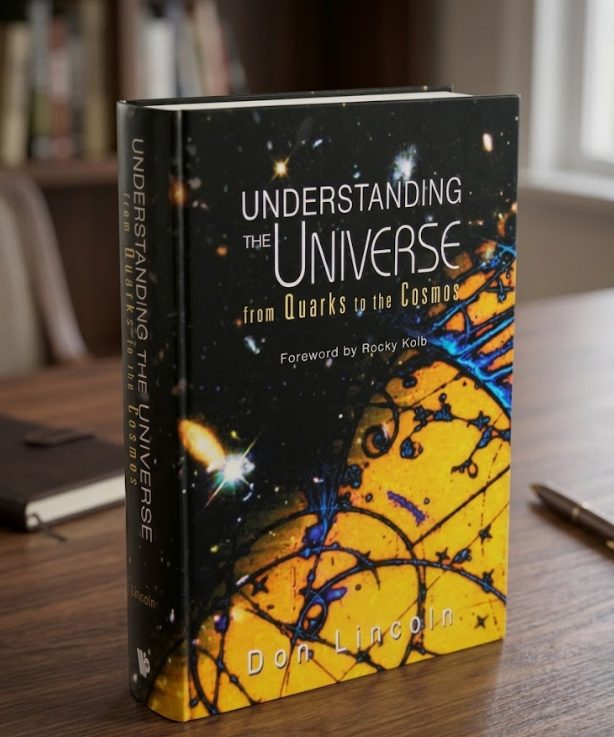
Dr. Don Lincoln‘s Understanding the Universe: From Quarks to the Cosmos (2004) is a masterwork of scientific exposition that takes readers on a journey spanning 2,500 years. It starts with early thinkers like Democritus and goes all the way to modern particle physics.
What makes this book special is not just that Lincoln knows a lot (he is a physicist at Fermilab), but that he explains things in a way that helps readers follow the journey of discovery. He doesn’t just give answers, he shows how scientists figured things out step by step, so readers can understand both the process and the results.
Lincoln takes us on the historical progression of physics. We start with the ancient Greeks wondering if matter is infinitely divisible and we travel through the discovery of atoms, electrons, nuclei, and finally quarks.
The journey starts with how Democritus proposed that “everything we see is made of common, fundamental, invisible constituents”. The idea that beneath the apparent chaos of the world lies simple, elegant structure, it’s the throughline of this entire book.
The structure follows particle physics itself, it starts from:
- elementary particles
- the forces that govern them
- the search for the Higgs boson
- the tools we’ve built to see the unseeable
- the mysteries that remain
It’s honest and straightforward, instead of acting like we know everything, Lincoln talks about the search for the Higgs boson as the big finale. He uses the very idea that even scientists do not know everything to show that uncertainty can be exciting and can drive discovery, making not knowing a central part of the story rather than a flaw.
The Architecture of Everything
Lincoln profiles John Dalton, the amateur chemist who revived atomism in the early 1800s. He traces the development through Mendeleev’s periodic table, which revealed hidden order in the chaos of chemical elements. He recounts Isaac Newton’s revolution in gravity, James Clerk Maxwell’s unification of electricity and magnetism, and the crisis of late 19th-century physics when Kelvin’s “two dark clouds” suggested the classical worldview was fundamentally broken.
The historical section culminates in the discoveries that define modern physics:
- cathode rays (J.J. Thomson’s electrons)
- radioactivity (Becquerel and Curie)
- the nuclear atom (Rutherford’s gold foil experiment)
Each story is told not as a collection of facts but as a genuine investigation. Lincoln emphasizes the role of failed experiments and unexpected findings, Marie Curie’s discovery that uranium consistently heated its surroundings, leading to her quest for the source of that energy. Thomson’s inability to be a skilled experimentalist in the traditional sense, compensated for by his genius for interpreting results.
This historical approach accomplishes something profound, it demonstrates that science is not a body of certain knowledge handed down from on high, but a human endeavor of exploration, error-correction, and conceptual revolution.
He tried to work around the problem, how can the universe be comprehensible at all?
Einstein famously said exactly that, and Lincoln quotes him at the opening of Chapter 5:
“The most incomprehensible thing about the universe is that it’s comprehensible at all”
This paradox, that our minds, made of the same quarks and gluons we’re studying, can successfully study quarks and gluons, hangs over the entire enterprise.
The primary theme is reductionism, that is, the pursuit of fundamental building blocks. Everything in the visible universe, Lincoln argues, can be constructed from just four particles of the first generation:
- an electron
- a neutrino
- an up quark
- a down quark
That’s it. Everything you see, mountains, oceans, stars, your body, is just endless combinations of these four minuscule objects governed by four forces. And knowing this feels that such vast complexity emerges from such profound simplicity makes it even more amazing.
The second major theme is unity through diversity. Forces that seem very different are actually just expressions of deeper patterns, like:
- gravity keeping planets in orbit
- electricity binding atoms
- the strong force holding nuclei together
The electromagnetic and weak forces aren’t different things, they’re two faces of a single electroweak force.
This idea of everything being connected shows up again and again in the book. This concept is not just limited to physics alone, but extends to almost all the other things in the world that we see around us.
The third theme, less obvious but perhaps deepest, is the limits of human knowledge meeting the boundlessness of human curiosity.
Lincoln doesn’t treat the Standard Model as the absolute truth. He shows it as the best way we know how to explain the evidence so far. When he talks about the Higgs boson, he reminds us that it hadn’t been found yet (in 2003) and shares other ideas, like Technicolor and supersymmetry, as real possibilities, not just guesses.
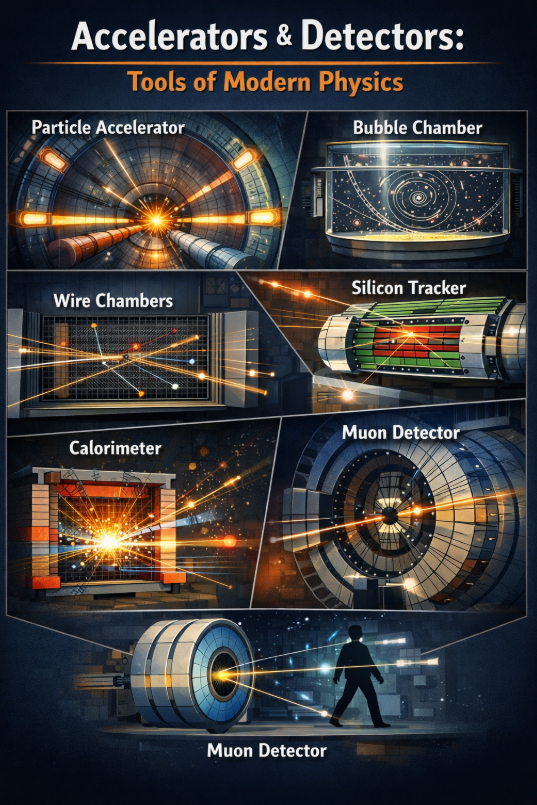
How Physicists Study the Invisible
I’d like to surface the extended discussion of experimental methodology used by the physicists as mentioned in the book. Many popular physics books focus on ideas and results; Lincoln dedicates an entire chapter to the accelerators and detectors that make modern particle physics possible. He explains:
- Particle accelerators: From Cockcroft-Walton machines to massive ring colliders, showing how increasing energy allows us to probe smaller distance scales
- Bubble chambers: The elegant simplicity of liquid hydrogen ionizing as particles pass through, tracked by magnetic fields
- Wire chambers: The revolutionary leap from Charpak’s invention, where ionized gas creates signals proportional to particle position
- Silicon trackers: Modern detectors using strips only 0.05 millimeters wide—20 of them fit in the space of a single millimeter
- Calorimeters: Devices that measure particle energy by inducing “showers” of secondary particles and catching their energy
- Muon chambers: Separate systems to identify muons, which pass through everything else
Lincoln explains why these tools were necessary and how they evolved, like:
- When physicists couldn’t achieve high enough speeds from bubble chambers, they needed faster detectors.
- When they needed better position resolution, silicon technology from the computer industry provided the answer.
The narrative shows how experimental limitations drive innovation, and how innovation opens new scientific possibilities.
Unsolved Mysteries in Modern Physics
Even after explaining so much, the book doesn’t pretend that physics has all the answers. Lincoln makes it clear that some of the most important questions are still open and actively being explored. He uses these unresolved problems to show how science is still in progress, not complete. This is where the story becomes less about certainty and more about curiosity and discovery.
Mystery #1: The Solar Neutrino Problem
Chapter 7, which Lincoln himself identifies as “the most difficult chapter in the book”, addresses mysteries that are partially understood, like the solar neutrino problem.
In 1964-1968, John Bahcall (theorist) and Ray Davis (chemist) proposed something that seemed impossible:
detect individual neutrinos from the Sun using 100,000 gallons of perchloroethylene (dry-cleaning fluid) placed 4,850 feet underground in the Homestake gold mine in South Dakota.
The challenge was staggering: they expected roughly 90 interactions over two months from 10^31 chlorine atoms. The extracted argon would need to be carefully counted, a technically brilliant but painstaking effort.
The results, announced in 1968, shocked the community, Davis measured only about one-third the flux of neutrinos from boron-8 fusion that Bahcall’s solar models predicted. This discrepancy persisted for decades.
The resolution involved an entirely new phenomenon: neutrino oscillations.
Mystery #2: Neutrino Oscillations and Neutrino Mass
Neutrinos come in three flavors: electron neutrinos (νe), muon neutrinos (νμ), and tau neutrinos (ντ). For decades, physicists assumed they were massless. But if neutrinos have mass, even a tiny one, they can spontaneously convert from one flavor to another in a process called oscillation.
The solution to the solar neutrino problem involves neutrino oscillations:
some of the electron neutrinos produced in the Sun convert to muon or tau neutrinos during their journey to Earth.
Since the Homestake detector was specifically sensitive to electron neutrinos, it measured a deficit.
Lincoln explains this elegantly, showing that the phenomenon was predicted theoretically and now has experimental confirmation from multiple sources, not just solar neutrinos but atmospheric neutrinos, reactor neutrinos, and accelerator-produced neutrinos all showing evidence of oscillations.
Mystery #3: CP Violation and Matter-Antimatter Asymmetry
Another mystery is the matter-antimatter asymmetry. Experiments show that matter and antimatter are created in equal quantities. The universe, however, is made almost entirely of matter. Where did all the antimatter go?
The answer involves CP violation, the idea that the laws of physics are not perfectly symmetric under charge conjugation (replacing particles with antiparticles) combined with parity (mirror reflection). If CP is violated, matter and antimatter might behave slightly differently under certain weak force interactions, leading to a tiny preference for matter production in the early universe.
CP violation was discovered experimentally in 1964, and its mechanism involves quantum mechanics at a deep level. Lincoln explains the phenomenon clearly but acknowledges that the full story, why the asymmetry is so large, and whether CP violation alone explains it, remains mysterious.

This Book is Part of a Bigger Conversation in Science
The narrative moves through big ideas that shape modern science. The idea of fields, (hidden forces that fill space) sounds imaginative until Lincoln’s examples make it easy to picture. For example, his Higgs field story, inspired by David Miller’s famous essay, shows Peter Higgs trying to walk across a room full of physicists. As he moves, people gather around him, making it harder for him to get through.
This is how particles gain mass, that is, through interaction with the Higgs field. The crowd above is the field.
This also connects to a bigger conversation happening in modern science writing. For example, books like The Order of Time explore the nature of time, Helgoland tries to make sense of quantum ideas, and Something Deeply Hidden looks at deeper interpretations of reality. Lincoln’s approach is different. He’s not trying to simplify everything or focus only on big philosophical ideas. Instead, he tries to be complete, he wants you to understand not just what we know, but how we came to know it.
The book also talks about how important experiments are in physics, which was a big topic around 2004. The top quark had only recently been discovered in 1995, and the Higgs boson still hadn’t been found. Lincoln spends time explaining real experiments, like
- how detectors work
- how scientists collect data
- how different teams at Fermilab compete with each other
This makes the book feel real instead of just abstract ideas. It’s a nice change from many popular science books that focus only on theories and not on actual experiments.
What makes this book different from most popular physics books is how much it talks about the tools and methods scientists use. Lincoln dedicates entire chapters to accelerators and detectors because he believes it’s just as important to understand how we discover things as it is to know the results. This idea is similar to what Thomas Kuhn said in The Structure of Scientific Revolutions that to really understand science, you also need to understand the tools and practices scientists use. Lincoln shows this naturally in the way he explains things.
The book also has affinity with Carl Sagan’s Cosmos, but where Sagan soars, Lincoln digs. Sagan was addressing humanity’s place in the universe, Lincoln is addressing the universe’s internal architecture. There’s a different kind of awe being solicited here, Sagan makes you feel small in a huge universe, while Lincoln makes you amazed by the deep mysteries hidden inside how everything works.
Does Knowing the Smallest Pieces Explain Everything?
Maybe the biggest deep idea in the book, even though it’s not said very directly, is about measurement, like how do you measure something that is so tiny you can’t even see it?
We already know that scientists don’t actually see these particles. Instead, they build detectors that show what happens because the particles are there, for example, a quark doesn’t show up by itself, but it creates a spray (called a jet) of other particles. A Higgs boson doesn’t appear clearly either, it quickly breaks into other particles, like pairs of bottom quarks. So you never really see the original thing, only the results of it.
It’s a bit like guessing something is there by the marks it leaves behind, we can categorise it as shadow. Although the author doesn’t focus too much on this idea, it’s always in the background whenever experiments are explained.
Similarly, the book raises questions about the limits of reductionism. Yes, everything is made of quarks and leptons governed by four forces. But is that the whole story? I mean, we cannot conclude everything about life by knowing the quantum mechanics of carbon bonding alone.
The book doesn’t claim to answer these limitations, but the very fact that it stops at the boundary of what particle physics can explain suggests Lincoln is aware of them.
I also liked the fact that Lincoln doesn’t pretend to know whether the Higgs boson will be discovered or whether supersymmetry is true. He lays out the arguments on multiple sides. He names colleagues who disagree with him and he calls himself a skeptic. This is the voice of someone secure enough in their knowledge to admit what they don’t know.
And he’s explaining things because he lives them as he comes to work at Fermilab, sits in collaboration meetings with hundreds of other physicists, analyzes detector data, writes papers.
The metaphors and analogies are particularly well-chosen precisely because they come from someone who lives the material. The description of the proton as “an unending lightning storm in a bottle” comes from Robert Kunzig writing in Discover magazine, but Lincoln quotes it because it captures something he understands in his bones.
The analogy of a scientist at a cocktail party (the Higgs boson analogy) works because it’s drawn from human social dynamics, something every reader understands.
The Takeaway: Science as Genuine Inquiry
If I try to place this book among other physics books, it feels like it sits somewhere in the middle. It’s a bit more detailed than Carl Sagan’s writing, but not as heavy as Brian Greene’s books on string theory. It also feels more focused on how science is done compared to Stephen Hawking’s style.
I think this book is best for readers who are curious and willing to think a little deeply, even if they don’t have a science background. It was written around 2003-2004, before big discoveries like the Higgs boson were confirmed. Reading it now, in 2026, feels interesting because we know some answers today, but many big questions are still open, like dark matter, dark energy, and why there is more matter than antimatter.
I personally liked the title “from quarks to the cosmos”, it really captures the idea that physics is trying to connect the smallest things to the largest ones. We understand some parts quite well, and other parts are still unclear. And that space in between, where we are still figuring things out, feels like where science is actually alive.
Overall, I found the book easy to follow but also thought-provoking. It explains things clearly without making the reader feel lost, and at the same time, it’s honest about what we still don’t know. It made me feel like learning science is a slow, shared journey rather than something that is already finished.